Posts by Elsa Sinikka Mäkinen

Compound interest is the key to wealth.
For the average person, the fastest way to grow wealth is to study and apply the concept of compound interest.
Your parents don’t understand it, and teachers don’t teach it, but if you want to turn your life around, you have to master it.
I’ve noticed that so many people—especially wage earners—are stuck in a “one-off transaction” mindset.
Don’t rush to disagree; I was the same way right after graduation. I only felt secure if the money was in my pocket immediately.
When starting a side hustle, I wanted to see cash the very same day.
If there was no movement after three days, I’d immediately switch to a different project.
It took stumbling a few times for me to realize that the logic of wealth in this world works quite differently.
At its core, compound interest is a “snowball effect” created by multiplying action over time.
If what you’re doing doesn’t become more valuable as time passes, you’re likely just spinning your wheels.
Some people will inevitably say it’s too slow, they can’t afford to wait, or it’s too much of a hassle.
But let me tell you: the people who quietly amass great wealth are the ones who have made compound interest a daily habit.
That habit could be reading ten pages a day, honing a specific skill, or consistently working on a small, monetizable product.
It brews slowly over time, helping you build a barrier to entry that others can’t copy, ensuring that every bit of effort you put in today pays you back manifold in the future.
I’ve seen so many people constantly chasing trends—doing this today, that tomorrow—and quitting if they don’t see results in three days.
Talk to them about long-term accumulation, and they say they can’t wait.
Talk to them about sustained investment, and they obsess over immediate costs.
The result? They spend years in a flurry of activity but have nothing to show for it; meanwhile, they get left far behind by the people who seemed to be moving slowly at the start.
The power of compound interest thinking lies in taking the long view and earning money for the future.
Many people claim to understand compound interest but then act inconsistently—working hard for a few days and then slacking off—which shows they haven’t grasped the true power of the “time lever.”
Wealth never comes knocking on your door on its own; it only rewards those who can settle down and stay the course.
Let me share a story from my own family.
My cousin started making regular monthly investments in index funds ten years ago.
While others were chasing market highs and lows—buying this stock today and selling that fund tomorrow—he remained unwavering, investing a portion of his salary every single month. Over the course of a decade, his assets grew nearly fivefold.
Now, passive income alone covers his entire family’s expenses.
More importantly, those ten years instilled in him immense discipline and a long-term perspective; he will never again be swayed by get-rich-quick schemes.
These are things no “crash course” can teach you; they can only be grasped by enduring the long haul.
You see, studying the power of compounding is ten thousand times more reliable than constantly chasing quick money.
Compounding forces you to confront human weaknesses—impatience, greed, the desire for instant gratification, and the tendency to quit halfway. Time will give you the most honest answer regarding whether your actions hold long-term value.
The market validates your choices through results; this is far more effective than any “guru’s” platitudes and holds more substance than any short-term gain.
Many people fear the cost of time, feeling they can’t afford to wait, but these are merely excuses. After all, if getting rich overnight were truly possible, who would choose the slow, grinding path?
A lack of persistence is the biggest mistake ordinary people make. If you just coast through your workday, the most you’ll learn is how to be a mere cog in the machine.
But if you privately commit to a habit that compounds—even if there are no immediate results—your understanding of wealth will already surpass that of 90% of people.
The process itself isn’t the scary part; what’s truly frightening is lacking the courage to even begin.
Here are three practical, straightforward methods that anyone can implement immediately:
First, start with one small thing you can stick to.
You don’t need grand gestures; simply read ten pages a day, spend an hour honing a skill, or write one piece of content weekly in a field you know well.
Even if no one reads it at first, and even if you don’t make money, just stick with it for three months.
Second, don’t wait for perfection before you start.
There is no such thing as being “fully prepared.” Just get moving and make adjustments as you go.
If today’s content isn’t great, revise it tomorrow.
If one method doesn’t work, try another. Every adjustment accelerates the compounding effect.
Third, emulate those who have succeeded through the power of compounding.
Don’t try to figure it all out on your own; observe what “long-term thinkers” are doing, deconstruct their actions, and learn from their mindset. There is no shame in imitation; copying a proven approach first, then refining it, and finally developing something of your own—that is what a smart person does.
Ultimately, the essence of wealth growth lies in the accumulation of value over time.
Every action you take today that holds long-term value will yield manifold returns at some point in the future.
Stop chasing short-term gratification; instead, make time your ally.
When you turn the power of compounding into a habit—as natural as eating or sleeping—you will find that making money becomes a natural, inevitable outcome.

Have you noticed that lately, America’s ultra-wealthy seem to be acting very strangely—almost as if they were colluding?
What earth-shattering inside information have they obtained that would cause this group to act so out of character?
Follow me, and let’s get to the bottom of this.
The people with the most money in the world have recently been quietly cashing out.
Since the start of the year, former world’s richest man Jeff Bezos has sold off massive amounts of his Amazon stock over nine consecutive trading days.
According to data from the U.S. SEC, he sold a total of 50 million shares, amounting to $8.5 billion.
Of course, for Bezos, that might just be pocket money for throwing a party.
But the thing is, he isn’t the only one doing this.
JPMorgan CEO Jamie Dimon also cashed out $150 million worth of shares in a single move a few days ago.
If you were to argue, “Hey, maybe he just wants to improve his lifestyle,” well, let me tell you something.
Historically, Dimon has only traded JPMorgan stock three times; the first two instances involved massive buying, whereas this time, he sold aggressively.
On top of that, the world’s wealthiest family—the Sam Walton family (the owners of Walmart)—has also rapidly sold off $4.5 billion worth of their company stock since the beginning of the year.
After the new year began, Warren Buffett sold shares of Apple—a stock he had held for eight years and regarded with almost religious conviction.
Airbnb co-founder Joe Gebbia sold $803 million worth of company stock in the first half of the year.
This happened even though the company’s share price rose by 68% this year.
Oracle founder Larry Ellison reduced his holdings by $848 million this year.
Current CEO Safra Catz also sold $470 million worth of company stock.
Yet, Oracle’s share price has climbed 48% this year.
You might call one or two instances a coincidence… However, when the world’s wealthiest individuals are quietly cashing out en masse, if you haven’t sensed that something is up, then you’ve still got a long way to go before you can strike it rich.
If you look a bit closer, you might realize that the truly bizarre aspect of this isn’t just the tycoons selling off their shares; it’s the fact that this is happening right when the US stock market is hitting new highs in a state of euphoria.
You have to realize that the prevailing narrative right now is that the US stock market is achieving legendary status—with Nvidia leading tech stocks to new peaks and retail investors piling in with a level of frenzy that borders on madness.
Yet, look at what these billionaires are doing: they are ignoring share prices that climb higher by the day, focusing instead on quickly offloading their stock and making a swift exit.
Given all this, I really can’t say for sure if the US economy is truly as risk-free and bubble-free as most analysts claim.
After all, these tycoons likely see things—insider details and broader trends—that the rest of us don’t, which is why they’re choosing an exit strategy that’s hard for us to even imagine.
So, wouldn’t you say this video is worth saving and watching a few times?
After all, there are some things I really can’t spell out too explicitly.

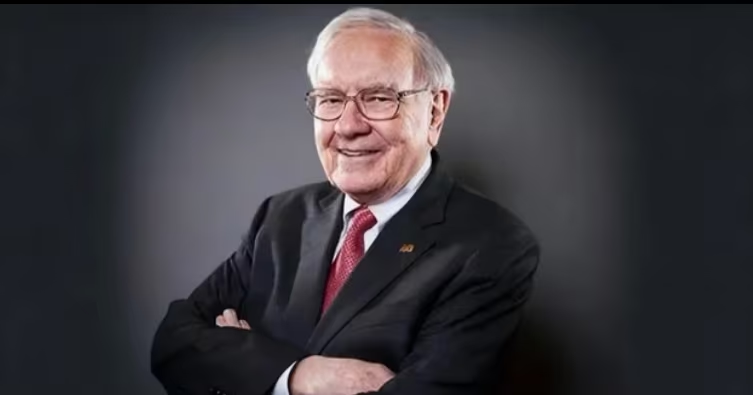
A wealth-focused interview from 2026 that is essential for the average person to deeply explore—revealing the profound insights Buffett has kept to himself.
On this leisurely Sunday, I revisited Buffett’s first in-depth interview since stepping down from active leadership. It was a two-hour session that I studied meticulously, frame by frame.
I gained so many new insights today.
This is arguably the most lucid—yet unsettling—prediction about the future I’ve heard all year. It is the ultimate conversation on wealth education and what lies ahead.
The interview is incredibly information-dense.
But the most striking aspect isn’t just the volume of information; it is the man himself—an elder statesman holding nearly $400 billion in cash who has just handed over the reins.
In the calmest of tones, he laid bare the ultimate survival challenge that ordinary people will face in the age of AI.
After listening, you will understand why he has successfully weathered four economic crises.
Why Munger said no one could surpass Buffett.
Why the world’s wealthiest people treat his words as a bible for wealth.
If you feel even a hint of anxiety about wealth, the future, job security, or your children’s education…
…this content could be the pivotal turning point for upgrading your mindset.
I recommend watching it repeatedly.
Much of this wisdom requires a calm, focused mind to truly internalize.
The first point concerns AI. This was the most explosive and serious part of the entire interview.
Buffett didn’t talk about investment opportunities in AI.
Instead, he equated the risks of AI directly with those of nuclear weapons.
That statement caused a stir across the internet.
Some claimed he was too old to understand new technology.
But I want to tell you: this is the insight of a true titan.
At 94, Buffett made a remark that gave me deep pause for thought.
“What worries me isn’t AI replacing workers.”
“It’s that it is replacing the act of thinking itself.”
Have you noticed?
We are plunging into an unprecedented crisis of cognition.
Because AI isn’t just a tool; it is a substitute for thinking.
When algorithms can instantly analyze a thousand financial reports, predict market sentiment, and even generate investment advice…
…the cognitive edge that ordinary people build up by staying up late to study and scouring financial news is being instantly obliterated.
Yet, the risks associated with nuclear weapons can be calculated and modeled. Yet, even the world’s leading AI experts admit they cannot accurately predict the trajectory or the ultimate tipping point of AI development.
It is akin to opening a Pandora’s box that cannot be closed.
Buffett’s words reflect the sober awe of a seasoned sage facing the tides of the times.
Even more alarming is the actual misuse of AI.
Buffett noted that there have already been numerous AI-driven “deepfake” scams impersonating him.
They were so realistic that they could fool even his own children.
And this is just the beginning.
Young people today constantly talk about AI and the metaverse…
Eager to pour their entire life savings into it.
Yet, they fail to realize they aren’t competing against other retail investors.
They are up against algorithmic teams capable of making decisions in 0.01 seconds.
Your “buy low, sell high” strategy based on gut feeling makes you look like a fool handing over money to raw computing power.
When AI can mimic anyone’s thought patterns…
What makes you believe your decisions are the result of independent thinking?
The decisions we ordinary people make—based on intuition and fragmented information—
May seem as childish as a game when pitted against AI.
Buffett teaches us, through a lifetime of experience,
That the proper stance in the AI era is to maintain a sense of awe regarding the unknown.
Do not follow the herd or blindly conform.
You cannot fight algorithms, nor can you control the ultimate direction of technology.
All you can do is stick to your own “circle of competence.”
No matter how the market shifts, steadfastly refuse to touch anything you do not understand.
This isn’t “lying flat” (opting out); it is the ultimate survival strategy for weathering market cycles.
Remember, those who successfully navigate risks are always the ones who respect the unknown and hold fast to their principles.
The second point concerns investment.
While the world speculates on Buffett’s next move…
He points out that Berkshire Hathaway is sitting on nearly $400 billion in cash.
Yet, he sees nothing worthy of investment.
Throughout 2025, he found no acquisition opportunities that met his standards.
This highlights a common misconception people have about money and wealth.
The biggest mistake ordinary people make in investing is confusing speculation with investment, and luck with skill.
They fixate on candlestick charts, chasing rallies and panic-selling during dips.
They go “all-in” based on hearsay and rumors. People fantasize about getting rich overnight without even understanding the company’s core business.
Fundamentally, they are no different from gamblers.
They fail to grasp the essence of cash: that it represents the power of choice.
Buffett has spent his life adhering to the principle of buying good businesses at reasonable prices.
He would rather sit on a massive cash pile—hundreds of billions—waiting for the right moment than blindly follow the herd.
I view this not as conservatism, but as a profound reverence for wealth.
The core of investing isn’t about how much you make, but how much you keep.
It mirrors the fundamental logic he uses to evaluate a business:
Is this a good business?
Do I understand it?
Is the management honest?
Is the price reasonable?
These four simple questions filter out over 90% of speculative traps.
Stick to what you understand; remain honest and grounded.
His investment philosophy sounds deceptively simple—almost like a platitude—yet few can actually put it into practice.
In the game of investing, refusing to touch what you don’t understand is ten thousand times more critical than blindly guessing at it.
The third point concerns life.
In this interview, Buffett shares the darkest moment that shaped his life as the “Oracle of Omaha.” As a high schooler, he was obsessed with horse racing. In a desperate attempt to win back his losses, he gambled away a full $50.
At the time, that sum represented the earnings from delivering 5,000 newspapers.
That visceral, painful lesson served as a wake-up call.
Horse racing is essentially a zero-sum game—or even worse, a game with compounded losses.
Everyone is merely fighting over a fixed-size pie.
Investing in good companies, however, is a positive-sum game that creates value.
The right approach to life is to commit to long-term endeavors.
This lesson kept him away from speculation and grounded in his principles for the rest of his life.
He never wavered, no matter how many temptations came his way.
The fourth point is about education.
We often say that to educate children well, we must teach them the ability to grow on their own.
In this regard, I believe no one does it better than Buffett.
After giving his three children their allowance, Buffett deliberately bought a slot machine for the house.
He used it to reclaim a large portion of the money he had just given them.
This move—infused with Buffett’s signature humor—served as a subtle lesson in financial literacy. It allowed them to grasp concepts like probability, risk, and the “house edge” through play.
It taught them clearly that getting something for nothing is merely an illusion. During the interview, Buffett’s famous maxim on wealth inheritance was once again reaffirmed.
He believes in giving children enough money to do anything,
but not so much that they can afford to do nothing.
Buffett has pledged to donate 99.5% of his wealth,
leaving only the remaining 0.5% to his three children—enough to pursue their endeavors, but not enough to simply coast through life.
He never interferes with his children’s life choices;
instead, through his own words and actions, he instills in them the importance of maintaining moral boundaries and embracing responsibility.
Today, his three children are deeply engaged in the philanthropic sector,
creating value in the fields of healthcare, poverty alleviation, and education.
Rather than living in their father’s shadow, they have become lights in their own right.
This highlights a common pitfall for many parents:
they focus on leaving behind houses and money,
while forgetting to teach their children to stay grounded and create value.
In the age of AI, skills become obsolete and wealth can dwindle;
only principles, kindness, and a sense of responsibility—deeply ingrained in one’s character—enable a child to stand firm.
The true purpose of education is never to churn out “test-score machines,”
but to shape individuals who possess inner confidence and adhere to moral boundaries.
Reflecting on this two-hour conversation, Buffett remained consistently humorous and composed.
He remarked that in the second half of life, one should become a better person—wiser than in the first half.
When asked how he wished to be remembered by future generations, he spoke not of wealth or investment returns,
but of being someone who loved his work and always strove to do the right thing.
Algorithms evolve, technologies innovate, and trends shift; the only constant is the wisdom that comes with the passage of time.
It is much like the winter sunlight in Omaha—quiet yet powerful, ordinary yet enduring.
What truly withstands the test of time is not the sharpest technology, but the deepest humanity.
As Buffett revealed in the interview, he spends 80% of his time reading and thinking.
This accumulation of “cognitive compound interest” constitutes the true “moat” that makes him irreplaceable by AI.
While we ordinary people may not possess his wealth, we can certainly replicate his “algorithm for living.” We study Buffett not to become billionaires like him, but to discover what ordinary people can hold onto in an uncertain future.
I have pored over nearly every classic work on Buffett, yet I found that *The Buffett Way* offers the most systematic explanation of his approach.
There are no candlestick chart tricks or get-rich-quick formulas; the entire book boils down to a single concept: winning.
Buffett’s wisdom is never about abstruse theories; rather, it stems from a clarity that returns to the fundamentals.
This is not merely a book on investing; it is a survival manual on how to remain simple in a complex world and stay true to the essentials amidst the surrounding noise.
If you wish to build an irreplaceable “cognitive moat”—much like Buffett—in the age of AI, this book is worth revisiting time and again.
Remember, the best investment is always in your own understanding; for when the tide goes out, those left swimming naked are invariably the ones who possess technical skills but lack depth of thought.d
Replying to @elsa_sinikka_maekinen

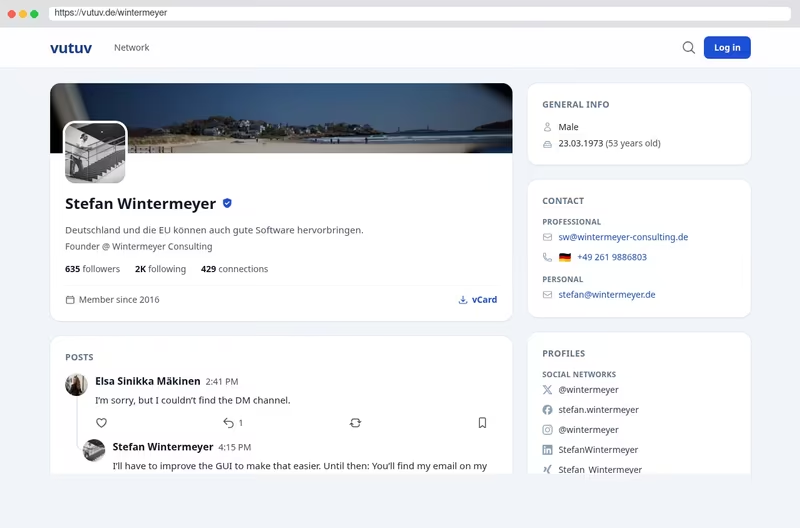
I’ll have to improve the GUI to make that easier. Until then: You’ll find my email on my profile vutuv.de/wintermeyer
Yes, I found the email address, but there’s no option to send FAS information.
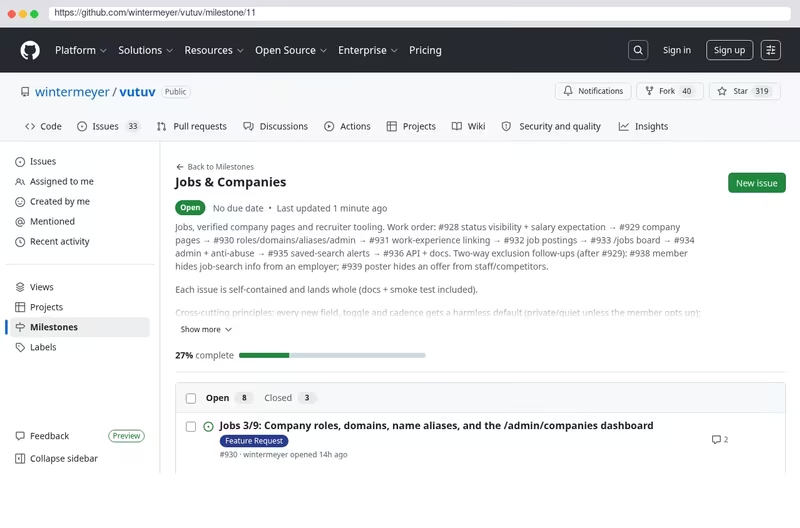
Die nächsten Tage kann es hier ein wenig Ruckeln. Ich arbeite an ein paar neuen Features zum Thema Stellenausschreibungen und Firmen. Nähere Infos hier: github.com/wintermeyer/vutuv/…
Also nicht direkt in Panik verfallen, falls mal irgendwo ein Menüpunkt nicht richtig ist oder irgendwas noch nicht 100% rund läuft. Wenn etwas auffällt, bitte ein Issue auf GitHub aufmachen. Das hilft mir am meisten.
Hi Stefan. This is my first time using this kind of software. Will you be able to receive my comment? I don’t seem to see a button to send a message.

Hello everyone, I’m Elsa. Although my roots are in Finland and work keeps me in Washington, USA, for much of the time, I have a deep love for the European lifestyle and spend my holidays in the South of France. I specialize in art installations and spatial art design, while also deeply engaging with AIGC-driven digital creative design; I am a cross-disciplinary designer who bridges physical spaces with digitally generated art.
My work centers on spatial storytelling and humanistic atmosphere, delivering comprehensive designs for commercial visual merchandising, exhibition installations, and immersive spaces. I am proficient in using AIGC tools for concept development, spatial rendering, installation form ideation, and visual atmosphere realization—leveraging AI to efficiently unleash creativity while refocusing on the emotional connection between people and space.
My creations balance the feasibility of physical implementation with avant-garde digital artistic expression, harmonizing artistic quality, project costs, and final results. I serve diverse settings including exhibitions, commercial retail spaces, cultural tourism showrooms, and brand art exhibitions as I continuously explore a new spatial design language that fuses artificial intelligence with physical installations.
You can view my work at 🌐 super-mango.pages.dev.