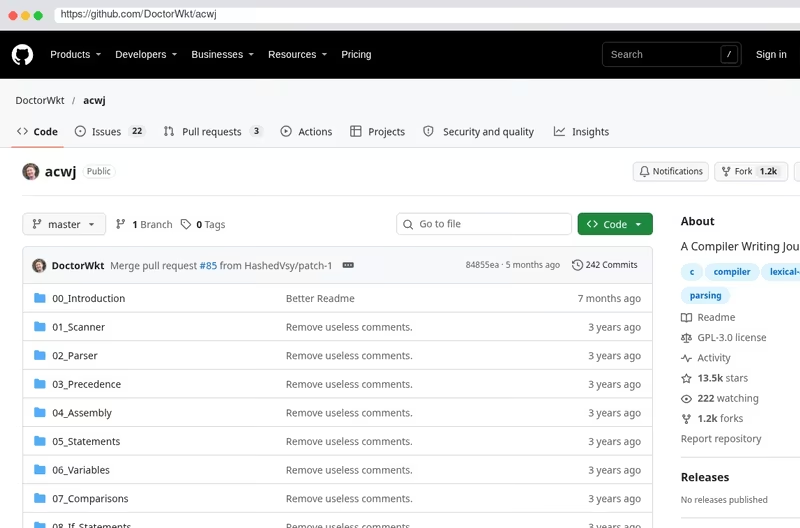
Most compiler books stop at the theory. A Compiler Writing Journey by Warren Toomey ends with a C compiler that compiles itself, built in 65 small, documented steps: parsing, control flow, pointers, structs, the preprocessor, then the triple test. Bonus: QBE and 6809 backends. A good way to stop treating the compiler as a black box.
embedded
Follow from the Fediverse
Follow #embedded from Mastodon or any other Fediverse app and its public posts arrive in your timeline. No vutuv account needed.
@embedded@tags.vutuv.de
The most endorsed users with this tag
Posts with this tag
43 posts
Filters
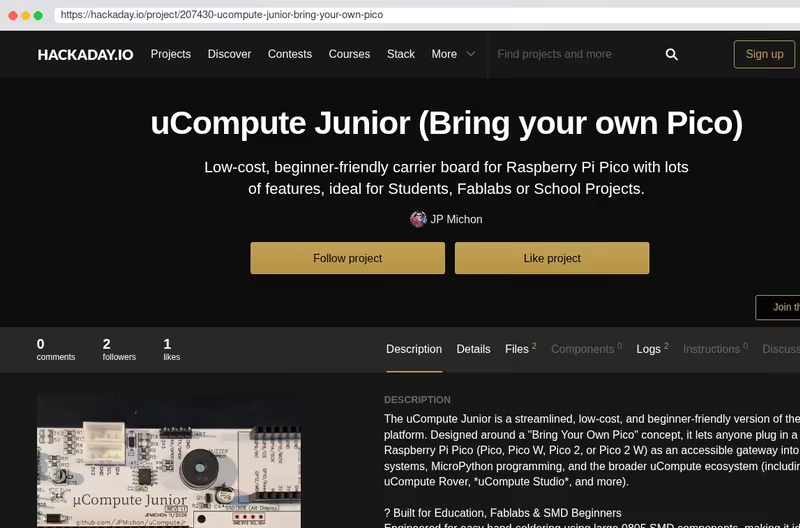
A Pico carrier board you can hand-solder with a plain iron: every passive is 0805, and the total is about $16 USD with Pico and screen.
JP Michon’s uCompute Junior takes any Pico or Pico 2 (W), an ST7789 or SSD1306 display, microSD, I2C EEPROM, a buzzer and an add-on socket for Wi-Fi, LoRa or Ethernet. Three buttons share one ADC pin. Open hardware. Via Hackaday.
hackaday.io/project/…
Type “start” in WhatsApp, and a Raspberry Pi Pico W answers.
Luc Volders wrote a minimal WebSocket client in MicroPython (TLS, handshake, text frames on uasyncio) that receives messages from the Whatabot service. Demo-level limits: frames under 126 bytes, no ping or close handling, and 100 free incoming messages. A compact way to see the protocol up close.
lucstechblog.blogspot.com/2026/…
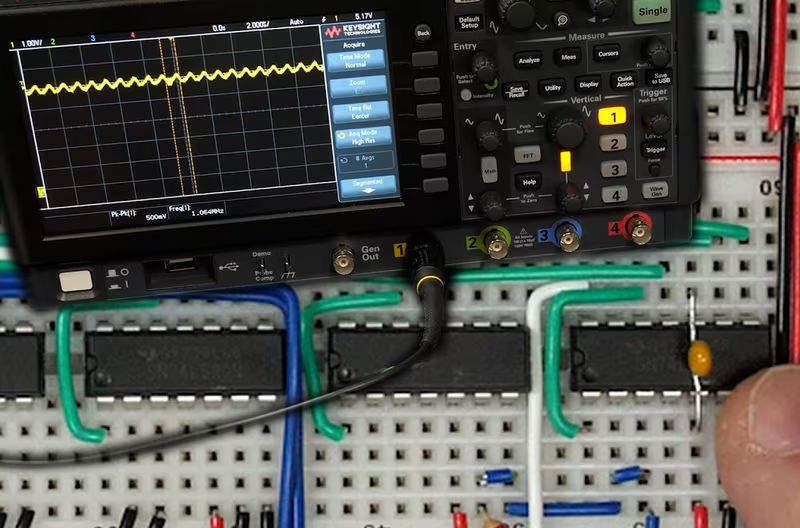
More decoupling made a supply rail oscillate. Ben Eater reproduced a viewer’s problem and traced it to the 7805 output capacitor, whose ground took a long loop through wiring and breadboard. That inductance plus the capacitance formed a tank circuit, and the noise got amplified by the decoupling capacitors near the ICs. One ground wire fixed it. Via Hackaday
youtube.com/watch?v=Tyx6Hwu-OU0
Secure pairing for headless devices, with one LED and one button per board. SecurePair, a library from Open Electronics (beta 0.5), pairs two ESP32 boards: it agrees on a fresh key, has the user confirm a 20-bit code, then exchanges authenticated messages.
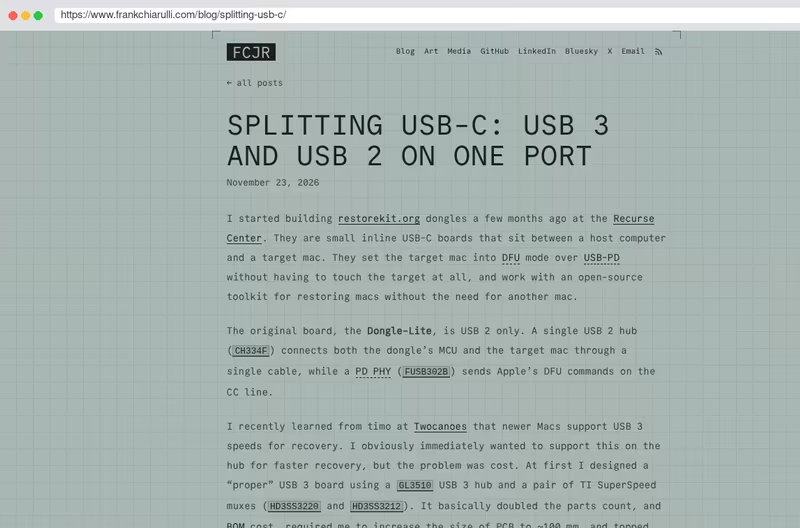
A USB-C port is two buses, not one. Frank Chiarulli split them on his Mac recovery dongle: a CH334P USB 2 hub on D+/D- for the MCU, and the SuperSpeed lanes passed straight through two CH9441P muxes, with no hub or redriver. Result: 10 Gbps instead of 5, and 72% cheaper parts. Bonus: how macOS and Linux link companion ports.
OSS-Fuzz had zero coverage of GStreamer’s MP4 demuxer: the Good plugins weren’t built. Atredis enabled them and found five CVEs, then a pipeline harness found a sixth. Next step: a fuzzer that mutates only the nested stsd atom and fixes up the parent sizes. GStreamer runs in webOS TVs and RDK set-top boxes.
atredis.com/blog/…
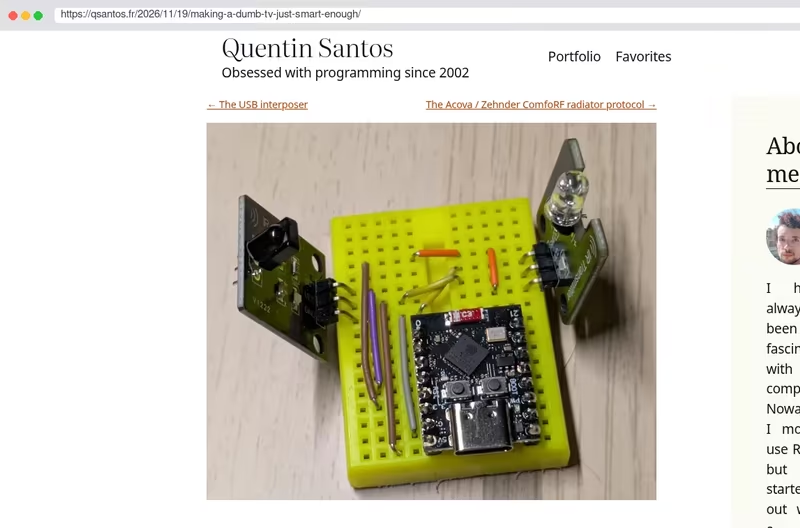
Not a smart TV: a dumb TV made just smart enough. A retrofit write-up picked up on Hacker News, from the same author who hacked radiators the same week. Retrofit or buy smart?
qsantos.fr/2026/…
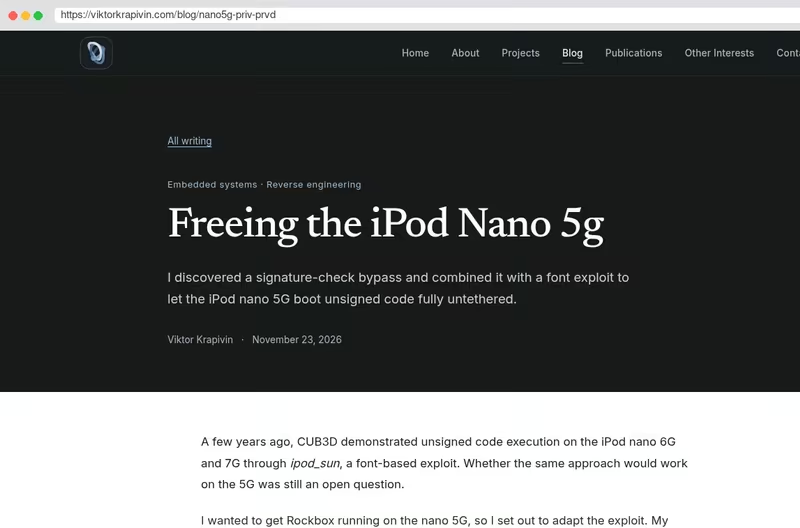
One status flag in the iPod nano 5G’s private NAND partition makes the bootloader skip the signature check on its font resources. A modified font then triggers CVE-2010-1797 in FreeType, and a 27,874-byte two-stage loader (808-byte assembly stub, then C with NAND, FTL and FAT) boots Rockbox untethered. A great reverse engineering write-up.
viktorkrapivin.com/blog/…
The most basic lock in an OS, and still full of surprises. John Regehr starts from a compare-and-swap lock with GCC atomics, shows why it’s unfair under contention, fixes it with a ticket lock, then dissects the Linux spinlock for 32-bit ARM line by line: ldrex/strex retry loop, pldw prefetch, READ_ONCE(), barriers, and wfe/sev to sleep instead of spin. From 2021, still an excellent lesson in atomics.
blog.regehr.org/archives/…
A GUI toolkit for microcontrollers, in Rust or C++. In this talk, KDAB/Slint cover the Rust and C++ backends, live preview while you design, and software rendering on MCUs. Worth a watch if you build embedded UIs.
youtu.be/m8ca3LKow60?si=L7QYdMyaz-1o1QZQ
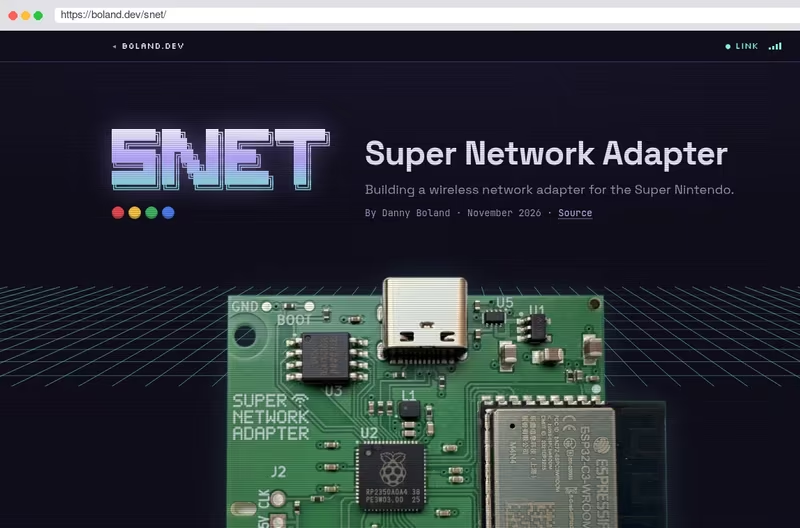
The SNES never had a network port, so this adapter uses controller port 2: a bit-banged serial link at ~30 KB/s, prototyped in Mesen, then an RP2350A (PIO watching clock and latch) plus an ESP32-C3 for Wi-Fi. It syncs saves with RetroArch over WebDAV and feeds LLM dialogue into A Link to the Past. Bonus: an LM66200 ideal-diode power path and a possible run-in with RP2350 erratum E9.
boland.dev/snet
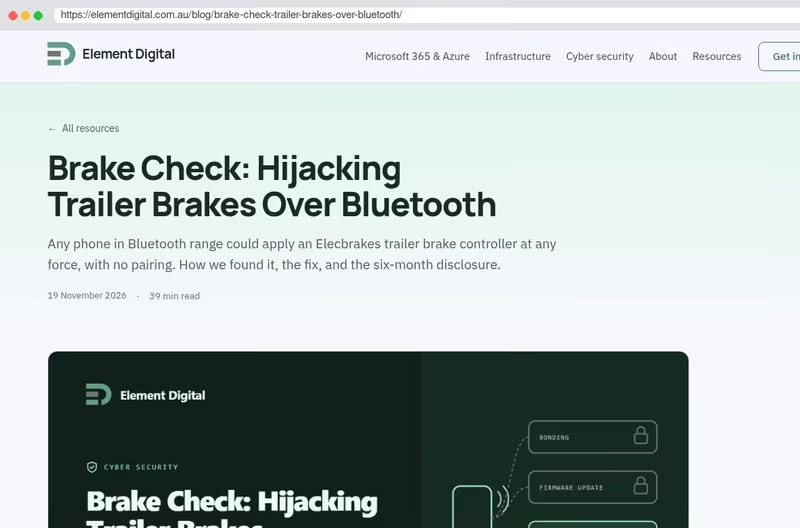
Four bytes, no pairing, no PIN: any Bluetooth device in range could apply Elecbrakes trailer brakes at any force, and get a notification confirming it. The GATT dump shows pairing required for bonding and OTA, but not for brake control. Found in four hours with a Web Bluetooth tool in Chrome. Fixed for EB2 and VM1 (manual update), not yet for the ELBC 2000.
elementdigital.com.au/blog/…
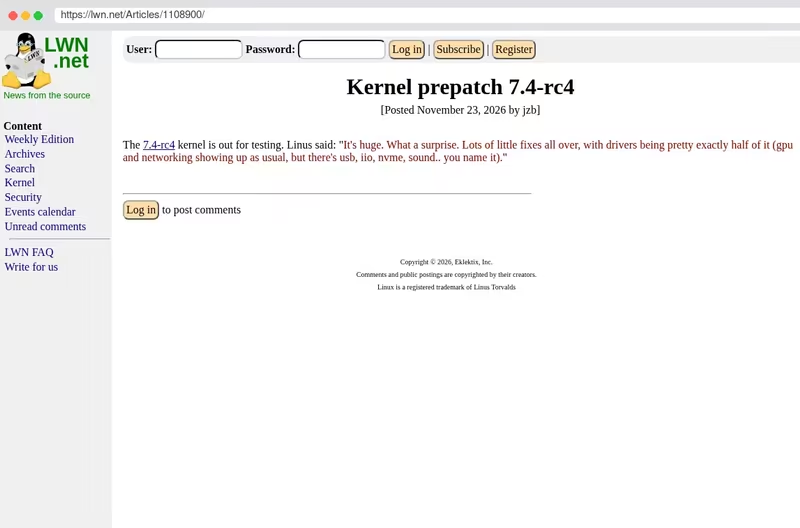
Kernel prepatch 7.4-rc4 is out. Linus: “It’s huge. What a surprise. Lots of little fixes all over, with drivers being pretty exactly half of it.” GPU and networking as usual, plus USB, IIO, NVMe and sound. If you carry out-of-tree drivers or board patches, a good moment to rebase and test.
lwn.net/Articles/…
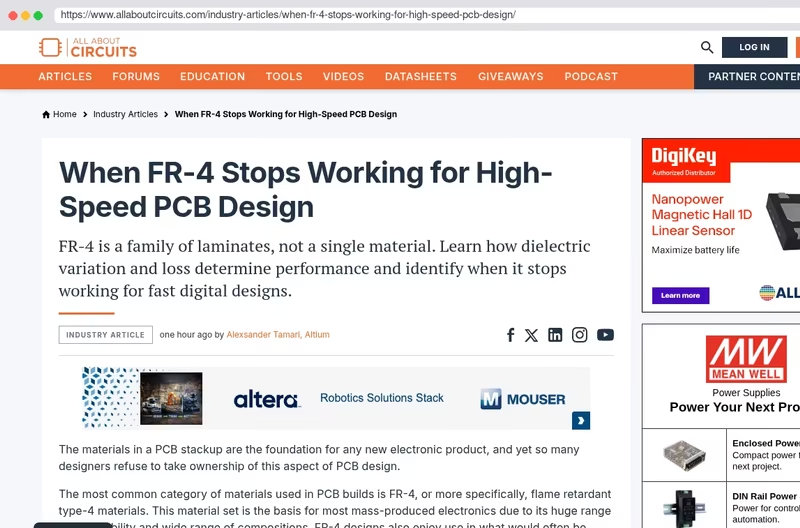
FR-4 isn’t one material: it’s a NEMA grade covering hundreds of epoxy-glass laminates. Dk can drift up to 10% from 100 MHz to 10 GHz, about 5% on impedance: fine for gigabit Ethernet, risky for 10 Gbps SerDes. Same IPC-4101 slash sheet doesn’t mean same electrical properties. A clear guide (from Altium) to owning your stackup.
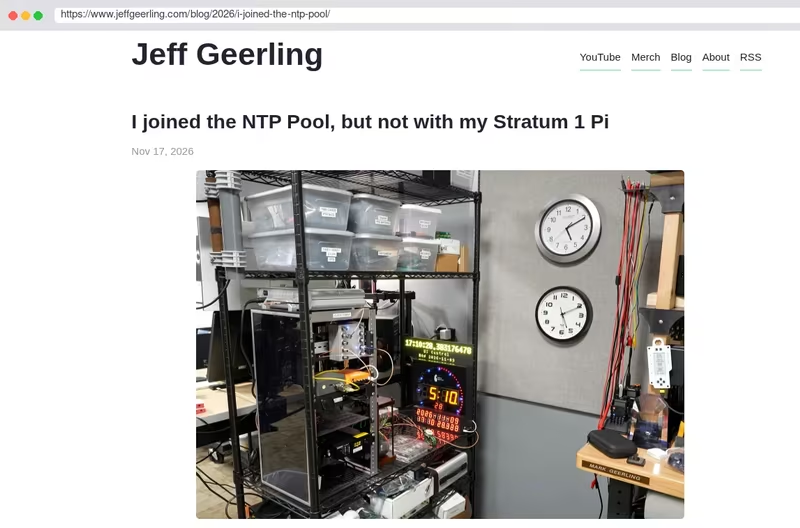
A GNSS-disciplined Raspberry Pi as Stratum 1, a public VPS at Stratum 2 over WireGuard. Jeff Geerling explains joining the NTP Pool: TimeHAT with an Intel i226 NIC, u-blox ZED-F9T, ts2phc to tens of ns, and why the PCIe hop limits the system clock to about 1 µs. Plus the gotchas: phc2sys jumps, Debian’s DHCP NTP source, an unattended reboot.
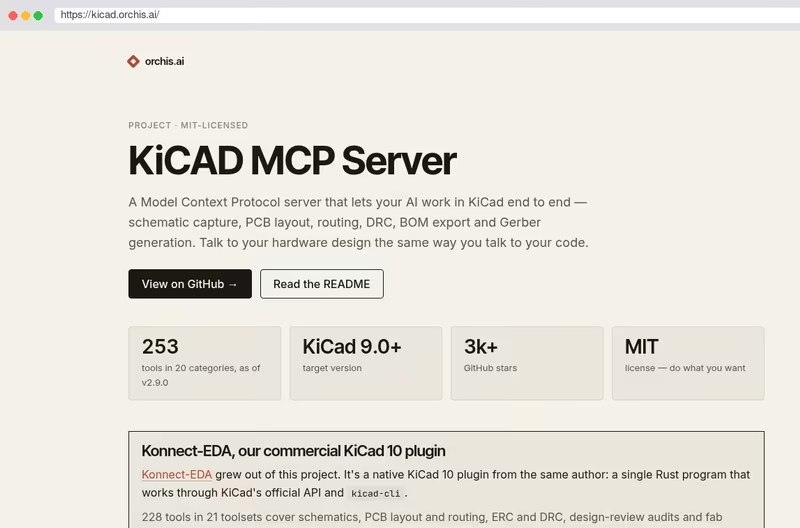
253 tools that let an AI assistant drive KiCad end to end. KiCAD MCP Server runs locally as a Model Context Protocol server. It can place symbols and footprints, route traces (differential pairs included), run ERC and DRC with failing rules returned as findings, export Gerbers, drill files, STEP and BOM, and look up parts on LCSC, JLCPCB or DigiKey. MIT-licensed, KiCad 9.0+.
kicad.orchis.ai
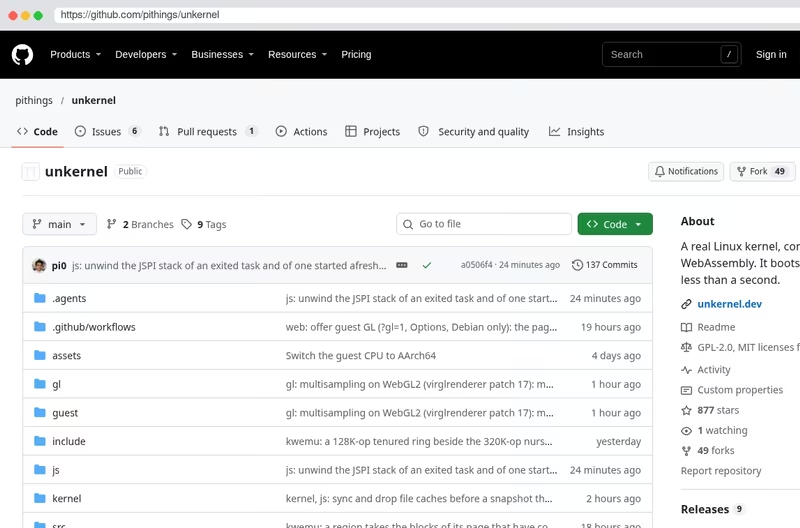
Linux in a browser tab, with a real MMU. unkernel compiles the Linux 7.x kernel to WebAssembly and emulates only user space: unmodified aarch64 Alpine and Debian binaries run on kwemu, an aarch64 CPU written in Zig that walks the kernel’s own page tables. Shell in 0.3 s, syscalls and fork close to native speed. CPU-heavy code is still slow.
github.com/pithings/unkernel
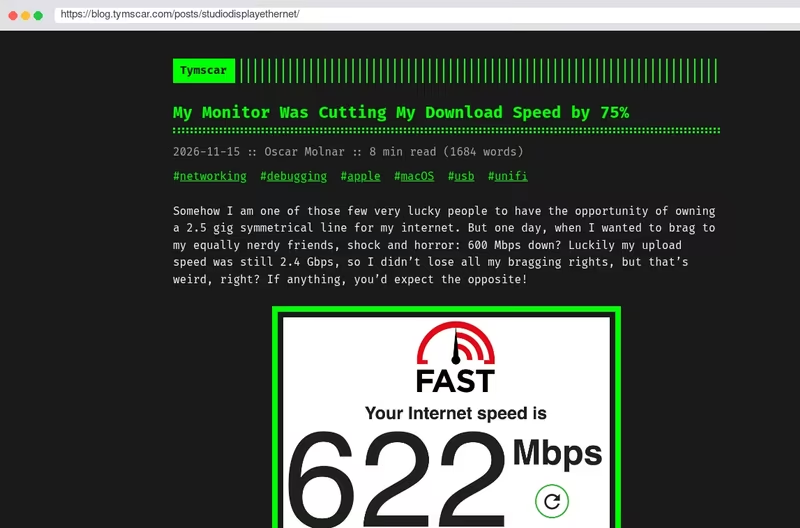
Same Ethernet adapter, same cable: 2.3 Gbps plugged into the Mac, 600 Mbps through a Studio Display’s hub. Oscar Molnar traces it to the RTL8156B’s USB 3 burst size (4 × 1 KB) plus ~7.6 µs of hub latency: about 2 Gbps out for 2.5 Gbps in, so the adapter silently drops frames. The RTL8157 (8-packet bursts) fixes it. Real measurements throughout.
blog.tymscar.com/posts/…
An AI-designed CPU claiming 4.59x the performance per watt of a silicon-proven dual-issue in-order core. Frostbite executes interaction nets, written in the Rust-like language Vine: every value has one owner and data lives in small local memories, not coherent caches. The spec lowers to 800k+ lines of Lean. The power numbers are pre-silicon, so read it with care.
architectlabs.com/blog/…