I changed team at the beginning of the week.
I have been a software developer for 16 years, I have now moved to cyber security.
Here is a glimpse at how my mind already evolved in just a couple of days 😲

Tags 4 followers
Follow #security from Mastodon or any other Fediverse app and its public posts arrive in your timeline. No vutuv account needed.
@security@tags.vutuv.de
Richard Cochius Geschäftsführer @ net at work GmbH
Mirko Wollenberg Senior Consultant @ DFN-CERT Services GmbH
Norbert Rüthers Information Technology Engineer @ Hemmersbach
Michael Kießling Software und Hardware @ Thinxnet GmbH
Rene Pisowotzki Head of ET Global Network
649 posts
I changed team at the beginning of the week.
I have been a software developer for 16 years, I have now moved to cyber security.
Here is a glimpse at how my mind already evolved in just a couple of days 😲


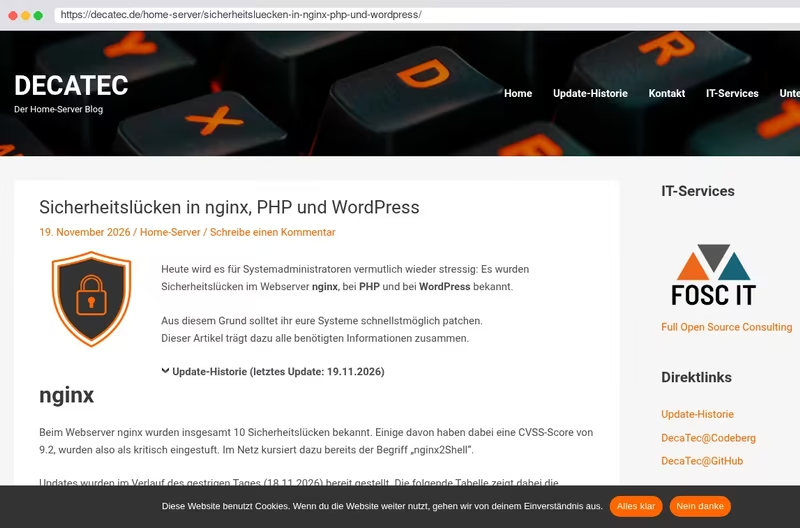
Gefühlt vergeht keine Woche ohne schwere Sicherheitslücken, diesmal hat es nginx, PHP und WordPress getroffen. Mittlerweile sind entsprechende Updates größtenteils verfügbar.
Dieser Blog-Artikel fasst dazu alle wichtigen Informationen zusammen und zeigt, wie ihr die Updates schnell einspielen könnt: decatec.de/home-server/…

📣 Announcing the immediate availability of:
‼️ These address the multiple critical security issues.
📝 php.net/ChangeLog-8.php
🎁 php.net/downloads?source=Y
Windows: php.net/downloads.php?os=windows
Issues list: php.net/ChangeLog-8.php#8.5.13

Security Alert: PHP (schon wieder) und Ruby2Shell
Security
Das PHP-Team hat angekündigt, heute, am 19. November 2026 zwischen 15:00 Uhr und 15:30 Uhr mitteleuropäischer Zeit eine als kritisch eingestufte Sicherheitslücke in PHP mit einem neuen Security-Release zu schließen. kantel.github.io/posts/… #Security #PHP #Ruby #Webworking #StatischeSeiten
 Sensitive. Show the picture.
Cover it again

ruby2ßhell: Remote Code Execution durch 21 ß
Kein Tippfehler: Eine neue Sicherheitslücke in Ruby heißt ruby2ßhell. Wegen falscher Verarbeitung von ß sind Ruby-Projekte wie GitLab und Mastodon angreifbar.
PHP behebt 17 Sicherheitslücken, vier erlauben Ausführung von Schadcode
Die kritischen Sicherheitslücken sind nur mit Vorbedingungen und nicht auf Standardinstallationen ausnutzbar; Admins sollten dennoch updaten.

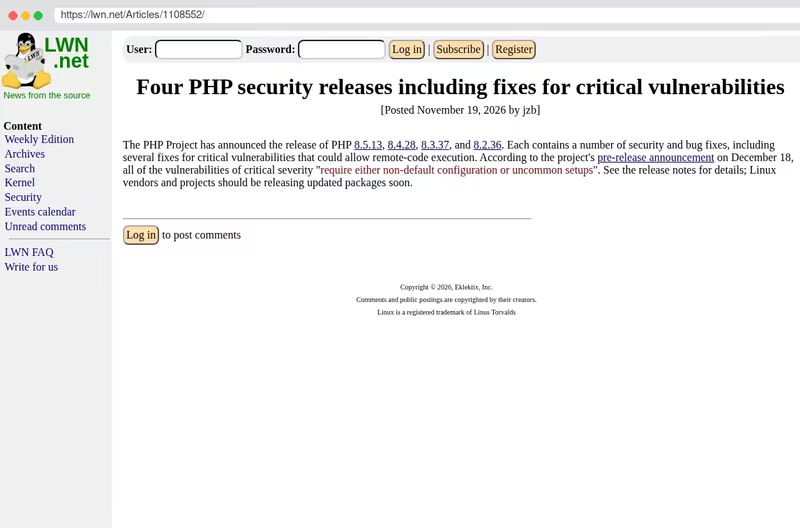
Four PHP security releases including fixes for critical vulnerabilities
Ubiquiti UniFi Access Application: Lücken erlauben Codeschmuggel
Sicherheitslücken in Ubiquiti UniFi Access Application ermöglichen Angreifern, Schadcode einzuschmuggeln oder Rechte auszuweiten.

🔒 New Kitten Security Release
Updates Kitten’s Node.js runtime to Node version 24.22.3.
(See Node’s blog post nodejs.org/en/… for details.)
All Kitten production servers that have auto updates on will be automatically updated within the next six hours. You can also manually upgrade any server from Kitten’s settings.

Fingerprints are the new cookies. Marcin Szleszynski explains how browser fingerprinting is replacing third-party cookies, and how Google’s changes paved the way. He shows how a few lines of JavaScript combine OfflineAudioContext, WebGL, canvas, Intl, and navigator signals, then hash them with SHA-256 into a nearly unique ID without any permission prompts. #security #js

Angriffe auf Lücken in Apache Axis und Roller, LiteLLM, Synology und mehr
Admins müssen den Update-Stand prüfen: Bösartige Akteure haben es auf Sicherheitslücken in Apache Axis und Roller, LiteLLM, Synology und mehr abgesehen.

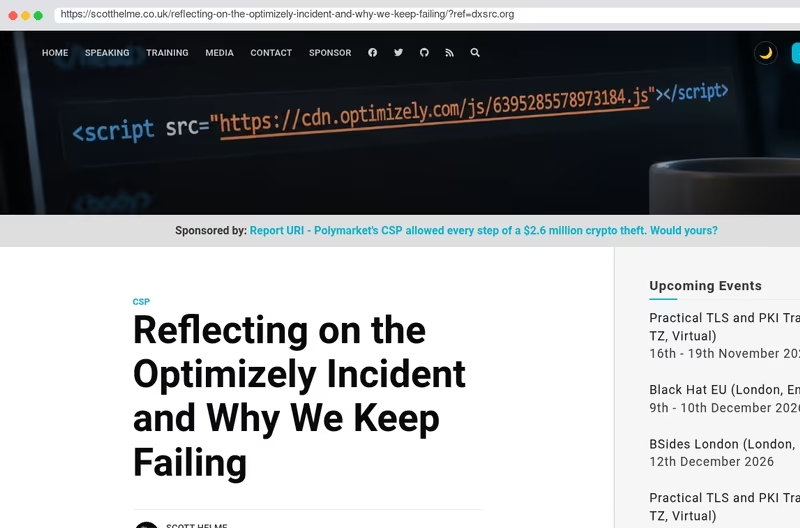
Reflecting on the Optimizely Incident and Why We Keep Failing, by @ScottHelme@infosec.exchange:

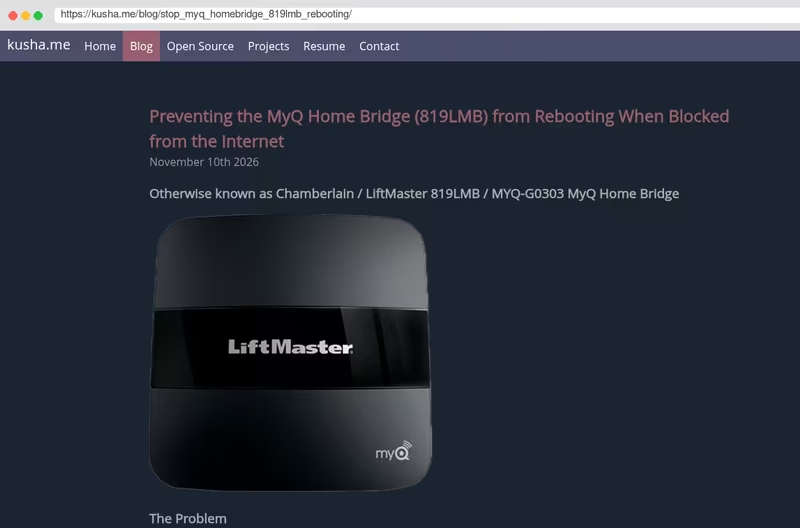
A garage door opener that reboots when it can’t reach the cloud. The fix: dump its AES key.
A reverse engineering write-up: extracting the AES key from a MyQ garage door opener so it stops rebooting when offline. A good reminder of what cloud dependency costs device owners.

🚨 URGENT: Self-hosters who use #NGINX reverse proxy should upgrade soonest due to multiple CVE’s that allow remote code execution.
The nginx-1.30.7 stable and nginx-1.31.9 mainline versions contain fixes for these critical vulnerabilities.
A workaround if you can’t update immediately is to disable http2, where that is on in your installation.
cve.org/CVERecord?id=CVE-2026-123633

Kritische Lücken in Nginx und PHP: Sicherheitsupdates für Webserver
linuxnews.de/kritische-luecken-in-nginx… #php #nginx #security #linux #linuxnews

Me: “Static websites are great for security! No CMS, no database, no PHP, no plugins. Just a few innocent HTML files. What could possibly go wrong?”
nginx: “Hold my CVE.”
Me: “Well, technically, I said the website was secure. I never said anything about the web server.”
And this, kids, is why we can’t have nice things. Not even an index.html.