astronomy

Tags

Follow from the Fediverse

Follow #astronomy from Mastodon or any other Fediverse app and its public posts arrive in your timeline. No vutuv account needed.

@astronomy@tags.vutuv.de

Your address is used once, to send you to your own server's follow dialog. It is never stored here.

The most endorsed users with this tag

Posts with this tag

5 posts

Filters
Prof Heino Falcke @hfalcke mastodon.social

Projects start small. Left is the first 3D print of the new Africa mm-wave Telescope (AMT) to observe black holes that will eventually have a 14 m width. Right is part of a drill core from the area where the telescope will be placed on Farm Göllschau near the H.E.S.S. telescope. Next year we will have a big dish there … #Astronomy #astrodon #telescope

A radio dish model displayed on a wooden table, with a view of trees and a road in the background. It looks like a satellite ground station.
A close-up view of a round, grayish-black rock with layered textures, resting on a light-colored surface.
AnySci - Wissenschaft für Jedermann @anysci mastodon.de

Leben unter dem Eis von Enceladus?

Unter der dicken Eiskruste des Saturnmondes Enceladus liegt ein globaler Ozean, an dessen Grund vermutlich heißes Wasser mit dem felsigen Kern reagiert.

Im letzten Jahr zeigte eine Studie, dass dort eine erstaunlich vielfältige organische Chemie stattfindet. Letztes Jahr war ich noch nicht hier, daher gibt es den alten Beitrag nur auf Facebook, aber ich verlinke die alte Studie auch nochmal unten.

Falls an dieser Stelle zu der älteren Studie mehr Infos gesünscht sind, teile ich den älteren Beitrag hier gerne auch nochmal. Einfach fragen.

Eine neue Arbeit setzt jedenfalls nun mit der Frage an, ob die bekante Chemie dieses Ozeans auf Enceladus tatsächlich einen Stoffwechsel ermöglichen könnte?

Dafür hat ein Forschungsteam der LMU München einige der vermuteten Bedingungen am Meeresboden von Enceladus im Labor nachgebildet.

In sauerstofffreiem, stark alkalischem Wasser kombinierten die Forschenden Mineralien, die dem felsigen Kern des Mondes entsprechen sollen.

Bei den Wasser-Gesteins-Reaktionen entstand Wasserstoff. Genau solche Prozesse könnten auch am Meeresboden von Enceladus stattfinden.

Anschließend gaben die Forschenden Methanothermococcus okinawensis hinzu, ein Archaeon, das ursprünglich an einer hydrothermalen Quelle in unserem Meer entdeckt wurde und Wasserstoff als Energiequelle nutzen kann.

Und tatsächlich wuchsen die Archaeen selbst bei einem pH-Wert von 11 und produzierten Methan. Das ist bemerkenswert, weil bei einem so hohen pH kaum frei verfügbares CO₂ vorhanden ist.

Der größte Teil des anorganischen Kohlenstoffs liegt stattdessen als Hydrogencarbonat und Carbonat vor. Genanalysen zeigten jedoch, dass die Zellen unter diesen Bedingungen verstärkt Teile ihres Stoffwechsels zur CO₂-Fixierung aktivierten. Offenbar konnten sie so selbst die sehr geringen CO₂-Mengen noch für ihren Aufbau nutzen.

Energie und Kohlenstoff für das Wachstum stammten damit letztlich aus Bedingungen, die gezielt nach dem Vorbild von Enceladus erzeugt worden waren.

Das bedeutet natürlich nicht, dass in dem Ozean dort tatsächlich Archaeen leben. ABer es könnte durchaus sein.

Einige der chemischen Voraussetzungen, die Cassini in der älteren Studie auf Enceladus nachgewiesen hat, könnten grundsätzlich ausreichen, um einen irdischen Mikroorganismus mit Energie und Kohlenstoff zu versorgen.

Quellen:

Helmbrecht et al., 2026, Science Advances
science.org/doi/…

Khawaja et al., 2025, nature astronomy
doi.org/10.1038/…

Bildquelle:

science.nasa.gov/solar-system/…

biologie astrobiologie science LMU enceladus
+8 Less saturn archaeen leben weltall astronomy wissenschaft wisskomm anysci
Das Bild zeigt den Saturnmond Enceladus vor dem schwarzen Hintergrund des Weltraums. Seine helle, eisbedeckte Oberfläche ist von zahlreichen Rissen, Furchen und unterschiedlich stark zerklüfteten Bereichen durchzogen. Einige Bruchlinien ziehen sich über große Teile der Oberfläche. Unter dieser Eiskruste befindet sich ein globaler Ozean aus flüssigem Wasser. Hinweise darauf lieferte unter anderem die Raumsonde Cassini. Sie beobachtete am Südpol gewaltige Fontänen, in denen Wasserdampf und Eispartikel aus Spalten der Oberfläche ins All geschleudert werden. Cassini flog mehrfach durch diese Fontänen und konnte ihre Bestandteile direkt untersuchen. Zusammen mit Messungen des Schwerefeldes und der Bewegung der Eiskruste sprechen diese Daten dafür, dass sich unter dem Eis ein globaler Ozean befindet. Die aktuelle Studie geht nun der Frage nach, ob die dort vermuteten chemischen Bedingungen grundsätzlich auch einen mikrobiellen Stoffwechsel ermöglichen könnten. Das Bild stammt von NASA, Jet Propulsion Laboratory (JPL) und Space Science Institute (SSI). Die Seite ist im Haupttext ebenfalls verlinkt.

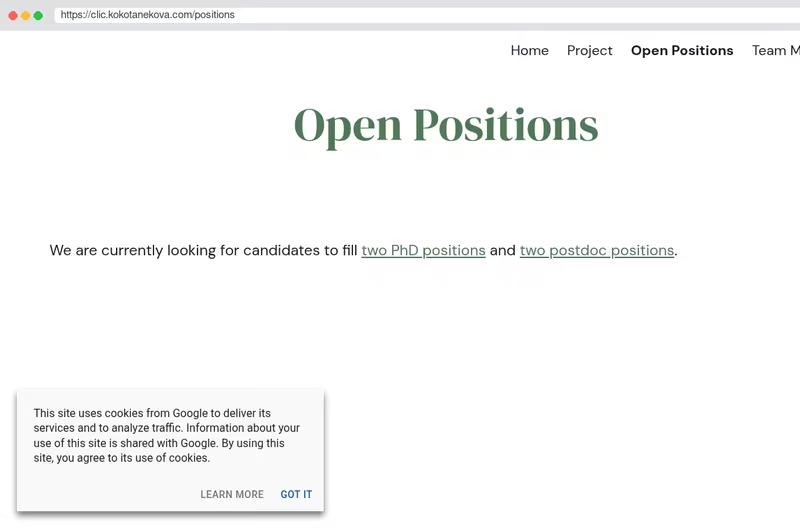
New research group by a dear former colleague now at the Institute of Astronomy, Bulgarian Academy of Sciences in Sofia: Cometary Life Cycle (CLIC) led by Rosita Kokotanekova …

… is looking for two PhD students and two Postdocs to study the physical evolution of comet nuclei and their links to other small body populations (TNOs, Centaurs, irregular moons, and dormant comets). The project is also closely linked to Comet Interceptor and Rubin Observatory’s LSST.

More at clic.kokotanekova.com/positions

Rosita adds: “I know Bulgaria is not a traditional top destination for young researchers, but this is a well-funded opportunity for independent, curious candidates open to the adventure.” Deadlines to apply to go on this adventure are September 30 for the PhD students, and October 31 for the Postdocs.

Comet CometaryScience JobAd FediHire PhD
+10 Less Jobs PhDPositions Postdoc PostdocPositions Astronomy Astrophysics Astrodon Space PlanetaryScience Bulgaria

A starry night, but in another galaxy ✨

Fly over the Magellanic Clouds, two galaxies orbiting the Milky Way, and discover a new stellar landscape — completely different from the one we see in our sky here on Earth.

1/2

📹 ESO/M. R. Cioni et al., VMC Survey, P. Horálek, Zdeněk Bardon, N. Risinger
🎵 Mylonite – Composition 129

astrodon astronomy astrophysics space science
A video panning over two irregular galaxies — wispy conglomerations of countless stars without a well-defined shaped. The text says: "Wonders of the Universe. The cores or the Magellanic Clouds. VISTA Survey Telescope. These are the Magellanic Clouds, two neighbouring galaxies about 200000 light-years away. New infrared images from ESO's VISTA telescope show their cores up close. These infrared images see through dust, revealing millions of stars in our cosmic neighbours."

A particularly popular post by @astrodicticum@chaos.social provides an opportunity to compare interaction numbers between Fediverse and Bluesky specifically for the German-speaking astronomy community, on the occasion of #ag2026garching this week:

chaos.social/@astrodicticum/… and bsky.app/profile/astrodicticum.bsky.soc…

At the time of the screenshots, the Mastodon post had 31 replies, 50 boosts, 213 likes, and the Bluesky post had 11 replies, 8 reposts, and 103 likes.

Follow numbers for Florian are 7.8K on Fedi and 6.4K on Bluesky.

My feeling (from occasionally monitoring other post pairs) is that the above interaction numbers are fairly representative, with engagement on Fedi being approximately double that on Bluesky.

Well, anyway. Congratulations to Florian via all available channels! 🎉

Mastodon post by Florian with 31 replies, 50 boosts, and 215 likes. The post shows a photo of Florian proudly holding a certificate towards the camera, and the post text explains in German that he has been awarded with the Bruno-H. Bürgel award of the German Astronomical Society.
Bluesky post by Florian with 11 replies, 8 reposts, and 103 likes. The post shows a photo of Florian proudly holding a certificate towards the camera, and the post text explains in German that he has been awarded with the Bruno-H. Bürgel award of the German Astronomical Society.

Keyboard shortcuts

Navigation

Home g h
Feed g f
Messages g m
Notifications g n
Your profile g p
Search /

Actions

Write a new post n
Send the post or message you are writing ⌘/Ctrl ↵
Next post in the feed j
Previous post in the feed k

General

Show this help ?
Close menus and dialogs Esc

The single-key shortcuts pause while you type, and are off on phones and tablets.