LLM agents ported an ML-KEM/ML-DSA accelerator to a Zynq UltraScale+ and it passed all its NIST tests. But the simulation gates killed only 76% of 399 netlist mutants, and scoped LLM review found planted key-custody flaws in just 3 of 20 sessions, while formal checks flagged every one.
semiengineering.com/measuring-verificat…
verification
Follow from the Fediverse
Follow #verification from Mastodon or any other Fediverse app and its public posts arrive in your timeline. No vutuv account needed.
@verification@tags.vutuv.de
The most endorsed users with this tag
Posts with this tag
7 posts
Filters
Hot off the academic press and recommended by our DW ReCo colleagues:
🔎 Fact-checking and Verification as Journalistic Methods 🔍
Editors: Andreas Önnerfors & Carl-Gustav Lindén
Fojo Media Institute, Linnaeus University
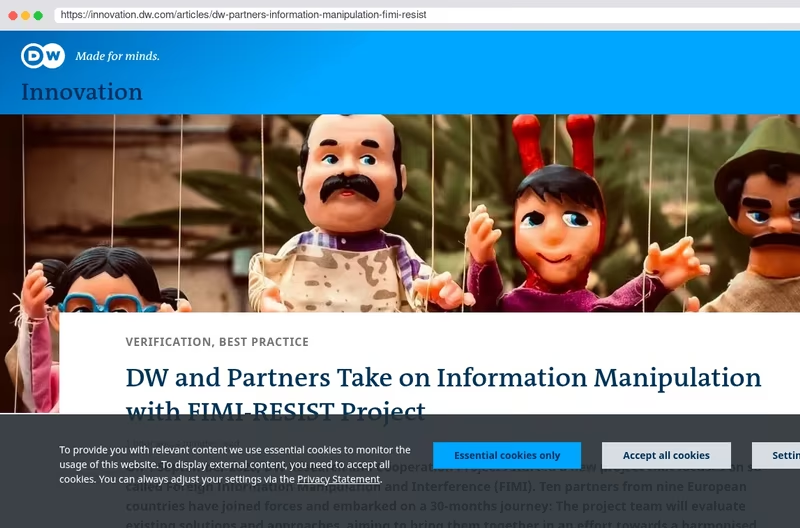
🔔 We’re part of a new project!
True to its name, FIMI-RESIST focuses on “Foreign Information Manipulation and Interference”, or FIMI.
“The project partners will examine which existing (European) tools, services and approaches are designed to support the likes of #journalists and fact checkers, among others, to effectively counter FIMI in all its forms and guises.”
👉 Find out more: innovation.dw.com/articles/…
“Dewi explains” Episode #05: SPOT. 🔍
This time, it’s all about next-level #geolocation #verification – and a really useful tool we’ve built right here, at DW Innovation.
Dewi is a big fan.
(brought to you by @Olivia_Luise@mastodon.social, @andygiefer@mastodon.social & @lxplm@mastodon.social)
Inside DW’s #FactChecking and #Verification process.
“To sum it up, our fact checks rely on in-depth research using OSINT tools, independent sources, transparency, detailed argumentation, clear verdicts and DW’s standards of impartial and unbiased journalism.”
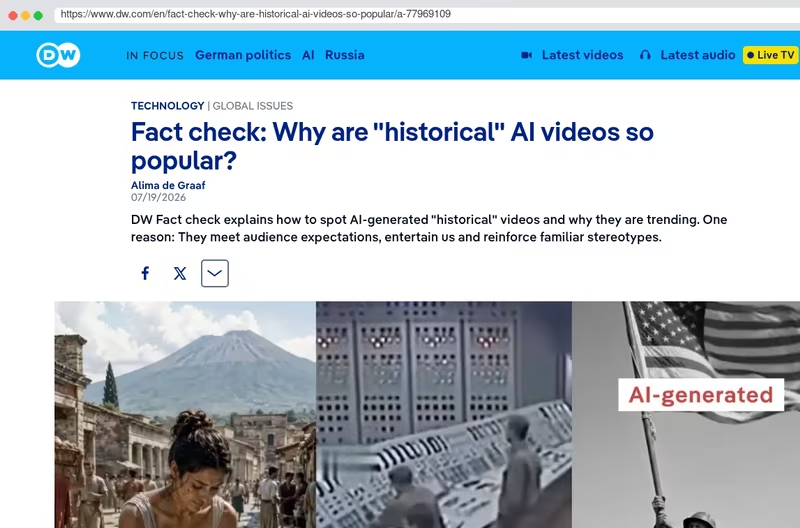
“AI models draw on both authentic sources and staged representations when generating such images. The datasets used to train these models include historical photographs as well as digitized paintings, film scenes and images from video games.”
For DW Fact Check, Alima de Graaf explains the trend of “historical AI” videos.
Some years ago, #android was fun.
It was kind of retro, hardware specs were low, you needed to code carefully making sure your code runs on a 320x240 pixels screen.
You simply installed your apps from the sd card or any webpage.
Now, it is no fun anymore. With every new version, #google imposes more and more restrictions that break sane apps.
It pushes useless #ui changes, just to make sure every #android version looks different & fancy.
It moves more and more code from the system core to their libs.
No, it ain’t fun anymore.
Google closes #android.
But you know what?
I don’t need to code for #android! I don’t need #dev #verification! I simply can write #multiplatform apps on #linux. There are dozens of wonderful frameworks and #ides available!
Fun moved elsewhere.