heise+ | Sicherheitsrisiko: Wenn kompromittierte Tor-Knoten SSH-Zugangsdaten stehlen
Anfang Oktober 2026 wurden Hunderte kompromittierte Tor-Knoten entdeckt, die SSH-Zugangsdaten stehlen. Betroffene sollten ihre Server neu aufsetzen.
Follow #tor from Mastodon or any other Fediverse app and its public posts arrive in your timeline. No vutuv account needed.
@tor@tags.vutuv.de
6 posts
heise+ | Sicherheitsrisiko: Wenn kompromittierte Tor-Knoten SSH-Zugangsdaten stehlen
Anfang Oktober 2026 wurden Hunderte kompromittierte Tor-Knoten entdeckt, die SSH-Zugangsdaten stehlen. Betroffene sollten ihre Server neu aufsetzen.

🔐 The offline master keys were not offline. Zimmer, who ran the largest group of hijacked Tor relays, said so in his post-mortem. Copies sat in a backup on his management server, encrypted with a password the attacker already found. 😬
He was just as blunt about the cause: The root cause was ours: one password reused for SSH login, sudo, and the backup passphrase, stored in plaintext on both servers, plus SSH password authentication left enabled on the internet-facing management server. Credit to him for putting that in writing. 👏 I’d guess plenty of servers out there would earn the same sentence, maybe a few of yours.
In early October, attackers took over more than 300 Tor exit relays and rerouted SSH connections to 12 interception servers. At the peak on October 4, those relays carried 7.46% of Tor’s exit capacity, according to an analysis of public directory data. Zimmer’s own break-in came earlier. On August 28, the attacker logged into his management server with the account password on the first try and gained root within five minutes.
The victims got hit through passwords too. To get burned, you had to accept the interceptor’s host key and type a password. Some people saw an OpenSSH warning that the server had changed… others just got the usual prompt to accept a new key. If you used key-based login, the attacker couldn’t pass it through to the real server because the signature is tied to that session.
The backdoor is Ebury version 1.8.3, a single library file that leaves the packaged library alone, so the normal package checks come back clean. Zimmer’s servers showed none of the host-level signs on the Tor Projects checklist. The only thing that gave it away was the changed exit policy.
🚨 If you run anything with SSH open to the internet, turn off password login and use keys. If you accepted an unfamiliar or changed host key over Tor between October 1 and 5, assume that password is stolen, change it, and check the server. And if you’re poking around a box you suspect, log in with a key, since Ebury captures typed passwords.
Nobody knows yet how the other 58 operators got hit. On FranTech, the network behind BuyVM, 71 of 101 relays switched to the attackers’ policy, compared with 13 of 9,054 hosted elsewhere. The researcher who spotted this asked whether the attackers got in at the hosting provider level, and so far nobody has answered.

Anfang Oktober hatten Angreifer einige Tage lang Zugriff auf 333 Tor Exits. Sie veränderten die Exit Policy zugunsten von unverschlüsseltem Mail-Verkehr und haben SSH-Verbindungen umgeleitet.
Blog-Post: kaba.cx/posts/…
Thread auf der Tor-Mailingliste: forum.torproject.org/t/…
Arstechnica: arstechnica.com/information-technology/…
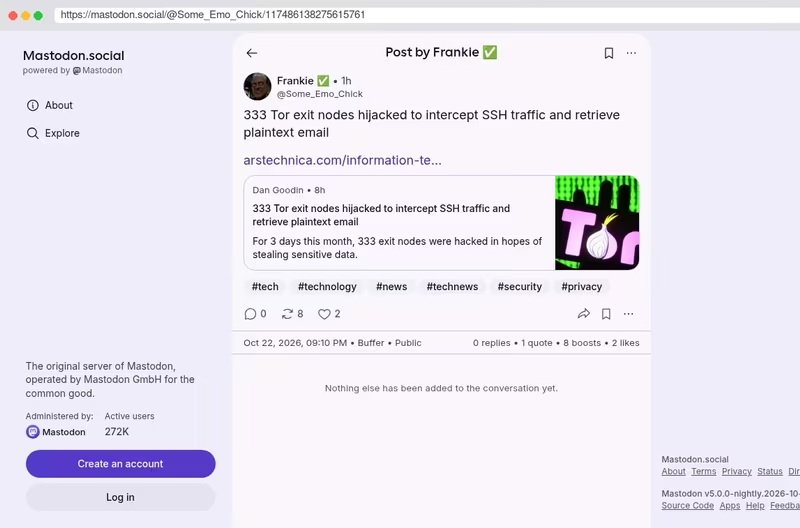
RE: mastodon.social/@Some_Emo_Chick/…
Und das hier ging bisher auch nicht durch die Öffentlichkeit: Angreifer hatten mal eben ~10% aller Tor Exits hops genommen
 Frankie ✅
@Some_Emo_Chick@mastodon.social
333 Tor exit nodes hijacked to intercept SSH traffic and retrieve plaintext email
Ist #Tor eigentlich noch sicher? Kommt darauf an, wofür Tor genutzt wird.
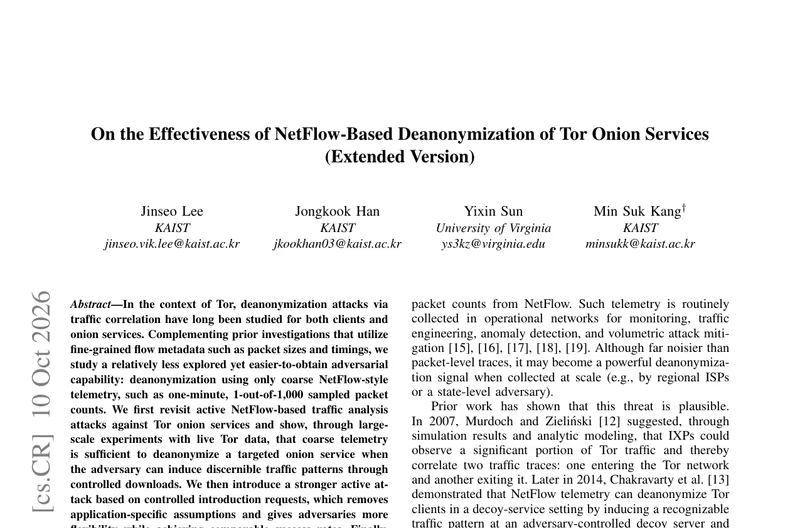
Forscher*innen bestätigen nun, was die Praxis schon seit einigen Jahren zeigt: Bei #Onion Services ist eine gewisse Vorsicht angebracht. NetFlow-Daten gefährden Ihre Privatsphäre:
On the Effectiveness of NetFlow-Based Deanonymization of Tor Onion Services (Preprint, to appear at IEEE S&P 2027)
arxiv.org/pdf/…

Anonymisierendes Linux Tails: Neuer Update-Rhythmus
Tails stellt auf einen zweiwöchentlichen Release-Rhythmus um. Version 7.13 der Linux-Distribution vereinfacht den Shutdown.