


kvm
Follow from the Fediverse
Follow #kvm from Mastodon or any other Fediverse app and its public posts arrive in your timeline. No vutuv account needed.
@kvm@tags.vutuv.de
The most endorsed users with this tag
-
Richard Zabel CEO @ Zagotec
-
Frank Meier IT-Administrator @ SYSGO AG
-
Stefan Heitmüller Senior Network Admin and DevOps
Posts with this tag
9 posts
Filters

I’ve always appreciated the simplicity of the BSDs. Power, yes, but without unnecessary complexity.
BastilleBSD and vm-bhyve have been my trusted companions for many years. But whenever I used Linux, I missed them.
That’s why, years ago, I started putting together a collection of shell scripts (and some Python, although to a much lesser extent) to create something somewhere in between.
A bit of Bastille, a bit of vm-bhyve, a bit of Proxmox: unprivileged Linux system containers and virtual machines, managed from the command line.
Live backups. And live restore: bringing a workload back online before all its data has finished copying from the backup. Multiple storage backends. Encryption at the storage or individual workload level. Different networks. Isolation of each workload (a bit like illumos zones), with additional layers of protection.
Each container has its own UID/GID mapping. VMs run under separate unprivileged identities, with namespaces, seccomp and resource limits adding further layers of protection.
Pull-based backups from external hosts, with different levels and types of encryption. With raw encrypted ZFS replication, the backup server doesn’t even need the decryption keys. Backups are pulled over SSH by an external server. The workload host holds no credentials to log in to that server.
It also runs on a 1 GB Orange Pi PC 2, where I’ve tested both containers and native ARM64 KVM guests. And on a Orange PI One, armv7 and 512MB, it can run some lxc containers without problems, from the SD, using f2fs.
Simple disaster recovery. Because after those 142 servers went up in flames in Strasbourg, disaster recovery became something I care a lot about.
Currently supported and tested on Alpine Linux, Debian 13 and Armbian. On Debian, LXC containers also run under enforcing AppArmor profiles, adding another layer of protection.
Few commands. Lots of power. And it’s called “Jail It!”
I’m not going to release it, at least not for now. I need to focus on my other projects, and Jail It! still needs some cleaning up.
But it works. And it does its job very well.
For containers, there’s absolutely nothing running in the background. For VMs, just a small Python helper. No continuously running services. You connect via SSH, run your commands, and that’s it.
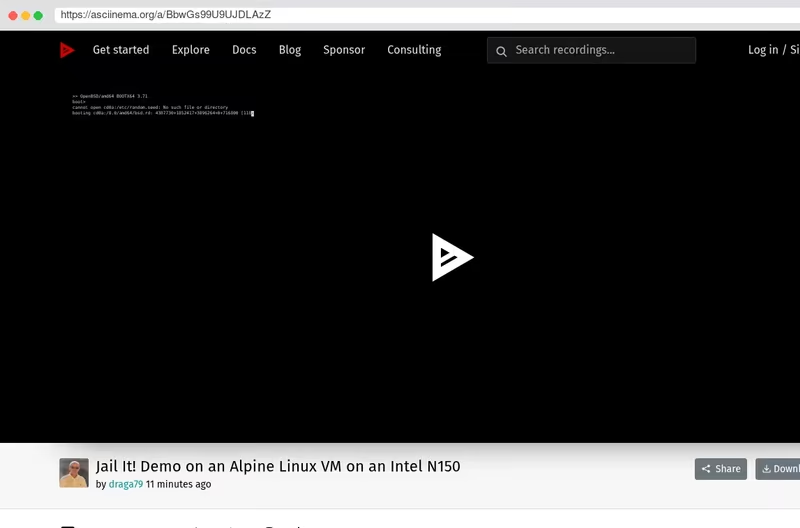
Still, for anyone curious enough to have a look, I’ve put together a short demo on Asciinema:
Well, “short” might be a bit of an exaggeration. It’s quite long, but I think it’s worth watching all the way to the end.

#bhyve live migration of a VM on #FreeBSD 15.1!
I really, really reeaaallly want to see #Sylve becoming a FreeBSD based replacement or alternative to #Linux solutions like #XCPng (#Xen) or #Proxmox (#KVM).
Also interesting for my own @BoxyBSD@bsd.cafe project utilizing this feature. So, I’ve been working at this for some time now.
First working draft moving a VM which has its storage on a NFS server (ZFS based send/rec. as local storage to follow), including multi CPU support. But there’s a catch - I’m not sure if I want to publish this later under MIT, rather than GPLv3 or AGPLv3, so this could be a problem for upstreaming.
RUNBSD

“But where do I find further information about the #Proxmox QDevice in my cluster?” - In #PegaProx!
The next release will be big and comes with an improved new corporate layout and many new features that make your life easier! Simple things like information about the QDevice or link speed of PVE nodes are now directly shown from the PegaProx UI. I don’t want to spoiler too much, so stay tuned for the next big update of PegaProx!

PwnEscape: Kritische Lücke in Linux-Kernel erlaubt VM-Ausbruch
Der Fehler steckt im Netzwerkbereich von Linux und ist, so die Entdecker, Teil einer neuartigen Klasse von Sicherheitslücken. Auch Cloud-Hoster sind betroffen.

TalosCon 2026: Sidero Labs erweitert Talos um Hypervisor und Enterprise-Produkte
Sidero Labs hat auf der TalosCon in Amsterdam die Alpha-Version des Talos Hypervisor sowie die VMware-Alternative Talos Director fürs Rechenzentrum vorgestellt.

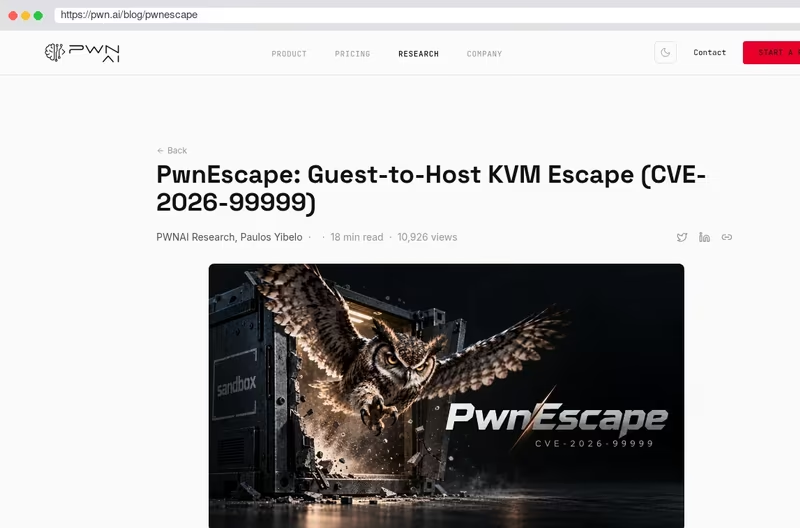
Heads up for fellow Linux admins: CVE-2026-99999 (dubbed “PwnEscape”) is out, and it is a nasty one (CVSS 9.3).
Despite being called a KVM escape, the actual bug lives in the host IPv4 networking stack. Untrusted CHECKSUM_PARTIAL offload metadata from a guest can overwrite already-validated packet headers during ip_do_fragment(), leaking host memory or allowing a guest-to-host escape.
Mainline patches landed Oct 14, and stable backports are out. Check your hypervisors and reboot!



Proxmox baut Enterprise-Support aus und gründet Tochtergesellschaft in Kanada
Ab Oktober bietet Proxmox einen Enterprise-Support rund um die Uhr an. Die Betreuung von Kunden in Nordamerika soll eine neue Tochter in Kanada verbessern.