JavaScript

Tags 2 followers

Follow from the Fediverse

Follow #javascript from Mastodon or any other Fediverse app and its public posts arrive in your timeline. No vutuv account needed.

@javascript@tags.vutuv.de

Your address is used once, to send you to your own server's follow dialog. It is never stored here.

Also known as

js, java script

The most endorsed users with this tag

Posts with this tag

24 posts

Filters
Christoph Schmees @PC_Fluesterer social.tchncs.de

Werbung und Tracking blockieren ist Notwehr!

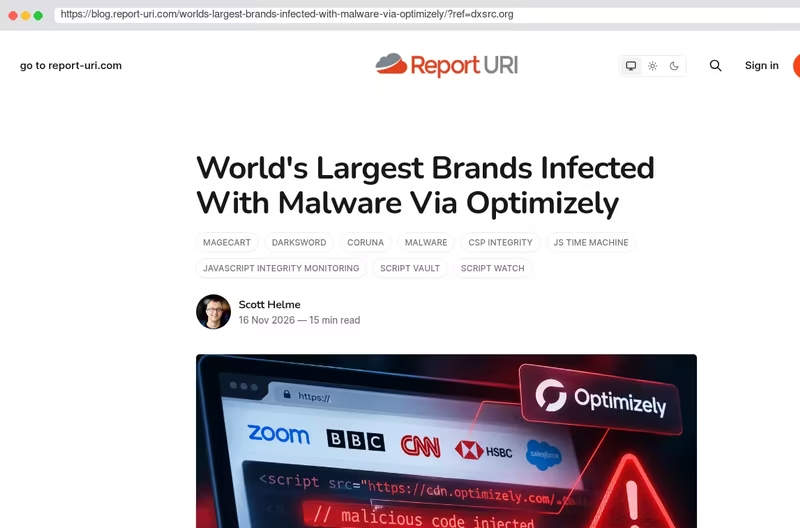
Werbung und das ihr zugrunde liegende Tracking ist nicht nur lästig und schadet der Privatsphäre, sondern kann real gefährlich sein. Darüber habe ich schon öfter geschrieben. Gerade liefert uns die Branche ein neues Beispiel, wie gefährlich sie sein kann. Diesmal geht es um die Firma Optimizely. Deren stille Dienste ermöglichen es Website-Betreibern, die Erscheinung ihrer Seiten an die jeweiligen Besucher anzupassen. Auf deutsch: “Die Kundenerfahrung verbessern”. Die Website-Betreiber binden dafür JavaScript (JS) von Optimizely ein. Bei mir nicht, weil ich mit NoScript Optimizely als “nicht vertrauenswürdig” abgeklemmt habe. … Weiterlesen:

pc-fluesterer.info/wordpress/…

cybercrime exploits javascript sicherheit UnplugTrump
+2 Less vorbeugen wissen

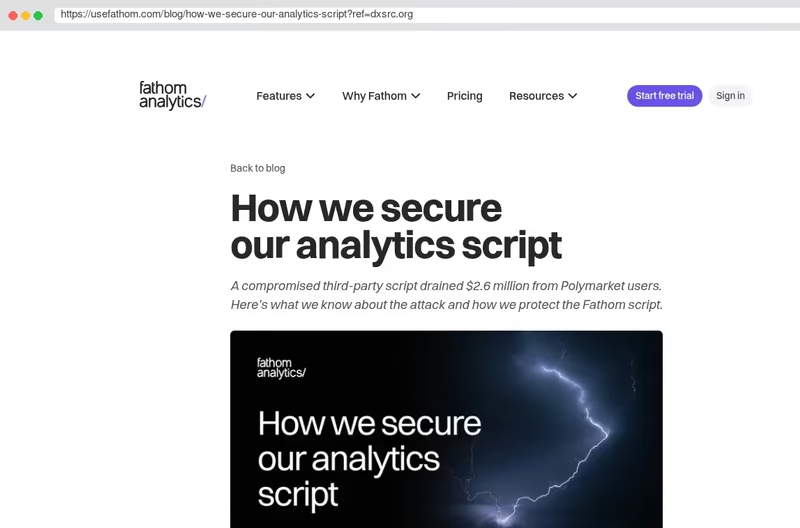
Fingerprints are the new cookies. Marcin Szleszynski explains how browser fingerprinting is replacing third-party cookies, and how Google’s changes paved the way. He shows how a few lines of JavaScript combine OfflineAudioContext, WebGL, canvas, Intl, and navigator signals, then hash them with SHA-256 into a nearly unique ID without any permission prompts. #security #js

royfish.dev/fingerprints-are-the-new-co…

Title “Fingerprints are the new cookies”, a card “Giddy Beaver” with a SHA-256 hash, and “Try refreshing the page. Clear the cookies. Connect to a VPN. You’re still the Giddy Beaver.”
silwol @silwol chaos.social

Da hat wohl jemand bei #Reuters seine Hausaufgaben nicht gemacht…

“Mithilfe von #JavaScript können Webseiten interaktiv gestaltet werden. Die Programmiersprache wurde ​vom SAP-Rivalen Oracle entwickelt […]. Oracle ‌war ⁠zwar für eine Stellungnahme zunächst nicht zu erreichen. Das Unternehmen hatte am Dienstag jedoch eine überarbeitete Version der Programmierumgebung #Java Development Kit veröffentlicht, mit der die Schwachstellen geschlossen werden ​sollen.”

reuters.com/de/…

Aral Balkan @aral mastodon.ar.al

🥳 New Kitten web site release!

The Kitten web site now has full-text search.

kitten.small-web.org

Written, of course, in Kitten.

The index is created lazily on the server in ~0.3 seconds (on my machine) the first time a route is requested after a server restart.

During dev, it’s fast enough that you don’t feel it during hot reloads :)

For the geeks among you, the search features Porter stemming (via the stemmer package), prefix matching on the last query term (which you can see in action in the screenshot), Damerau–Levenshtein distance (so we’re forgiving of little typos), as well as a few code-related optimisations like decomposing camelCase compounds (so WebSocket also matches “web” and ”socket”), etc.

(Oh yeah, and it uses the nifty new baseline URL text fragments feature¹ to have the browser take you straight to the search term in the body of the text.)

Enjoy!

💕

¹ developer.mozilla.org/en-US/…

SmallWeb SmallTech Kitten web dev
+5 Less NodeJS JavaScript HTML CSS peerToPeerWeb
Screenshot of the new full-text search bar in Kitten showing 60 results for “streaming ht” with “Streaming HTML” as well “HTML” highlighted in the responses, the top two being the Streaming HTML tutorial and the Streaming HTML section under Reference > HTML.
Aral Balkan @aral mastodon.ar.al

🥳 New Kitten release!

• Event routing within nested components is now more intuitive and logical.

e.g., a button on a form that was written into the slot of a layout component by a page. In this case, the event is routed to the page first, since the form was written into the slot by the page, whereas, previously, it would have been routed to the layout component.

Also, if the initial target doesn’t implement a handler for it, the event is now also delivered to the component around the element (in this case, the layout) and any other ancestors it might have.

• Components that update() themselves now retain the props and slot content from their last render. Again, this just means they work as they should now.

• Markdown pages now get linked anchor headings by default and you can turn the feature on for your own Markdown blocks in JavaScript pages by including the new headling-links attribute in your <markdown> tags in Kitten’s tagged template strings. e.g., kitten.html<markdown heading-links>…</markdown>

• New preserve attribute lets DOM elements opt out of morphs (e.g., when you want to retain the text entered into a text-field while morphing the rest of the page using Kitten’s Streaming HTML workflow).

• Miscellaneous bug fixes and improvements.

See the change log for the full list of changes including illustrative code samples:

codeberg.org/kitten/…

Also, I’ve reworked the Reference section of the Kitten web site so it’s no longer just one big dump of information. It’s now split into multiple pages, organised by section, and includes much nicer internal navigation:

kitten.small-web.org/reference

You can install and play with Kitten from the Kitten web site:

kitten.small-web.org

Enjoy!

💕

Web Standards @webstandards_dev mastodon.social

Framework performance. A new project by @e18e@webtoo.ls benchmarks nine meta-frameworks, from Astro and Next.js to Nuxt, SvelteKit, and TanStack Start: dependencies, install and build times, server throughput, and Core Web Vitals. Astro ships just 3KB on initial load and handles 767 requests per second. Next.js ships 140KB, handles 145, and is the only one that still ships core-js polyfills. The tests run in CI for every new version. #performance #js

frameworks.e18e.dev

The e18e logo, title “Framework Performance”, sections Dev Time, Run Time, and Core Web Vitals, and a bar chart of framework timings from Astro at 89.00 ms to Next.js at 344.00 ms.
Aral Balkan @aral mastodon.ar.al

One of the exciting new features in the Kitten API version 1 release I made over the weekend is automatic updates.

When automatic updates are on, a deployed Kitten server will:

  1. Check for updates to Kitten as well as the installed Kitten app at an interval that you can customise.

  2. Correctly handle updates between major (breaking) Kitten versions. (In other words between Kitten API versions, e.g., from 1 to 2, 2 to 3, etc.) This includes ensuring that the installed app has a compatible version before upgrading and seamlessly handling app upgrades across breaking changes.

  3. Rollbacks: if, for whatever reason, an upgrade fails, it is automatically rolled back (this includes your databases).

The only thing you need to add to your apps to take advantage of this is an engines.kitten entry to your package.json file set to the API version your app has been tested with (currently, should be “1”).

You can also, of course, manually update both Kitten and your app before the next check via Kitten Settings (see second screenshot) and you can also set up a webhook so that pushing to your main or release branch updates the app immediately on a single server.

If you app has a release branch, that’s what Kitten checks for updates and you can deploy, e.g., from main, using git push origin main:release. Otherwise, Kitten will check your default branch, which is usually main.

For more details, see:

⁃ Updating Kitten: kitten.small-web.org/reference/…

⁃ Versioning: kitten.small-web.org/reference/…

You can get and play with kitten at kitten.small-web.org

Enjoy!

💕

Kitten SmallWeb SmallTech web dev
+5 Less HTML CSS JavaScript automaticUpdates deployment
Screenshot of the Kitten Settings → App page on the Kitten site (https://kitten.small-web.org/🐱/settings/app/) showing the installed and available versions of the currently-deployed app, its local path on the machine, and instructions for setting up a deployment web hook.
The same Settings → App page, scrolled to the bottom, showing the webhook URL, webhook secret (masked) with Show/Copy/Change buttons and, the highlighted section: Update app, showing that a newer version of the current app is available (in this case in the release branch of the repository) with a link to view the changes between the installed version and the latest one. The message also advises that you update, you should make sure the app supports Kitten API version 1. Finally, there’s a button labelled Update to latest commit. Under the highlighted section is a Deploy new app section that you can use to deploy a different app to the server.
Screenshot of Codeberg showing a compare commits view. This is the page you reach when you click the link to view the differences between the current and latest versions of the app.
Aral Balkan @aral mastodon.ar.al

🥳 New Kitten Release

kitten.small-web.org

• Node.js runtime upgraded from version 24.2.1 to 24.2.2.
• A cosmetic simplification of the update history in Kitten Settings (the page no longer reproduces change log entries, choosing instead to link to them).

Full change log: codeberg.org/kitten/…

Enjoy!

(Deployed servers will automatically update at their next check interval. You can update manually from Kitten Settings or by running the kitten update command.)

💕

Kitten SmallWeb SmallTech kittenRelease web
+4 Less dev NodeJS JavaScript peetToPeerWeb
Web Standards @webstandards_dev mastodon.social

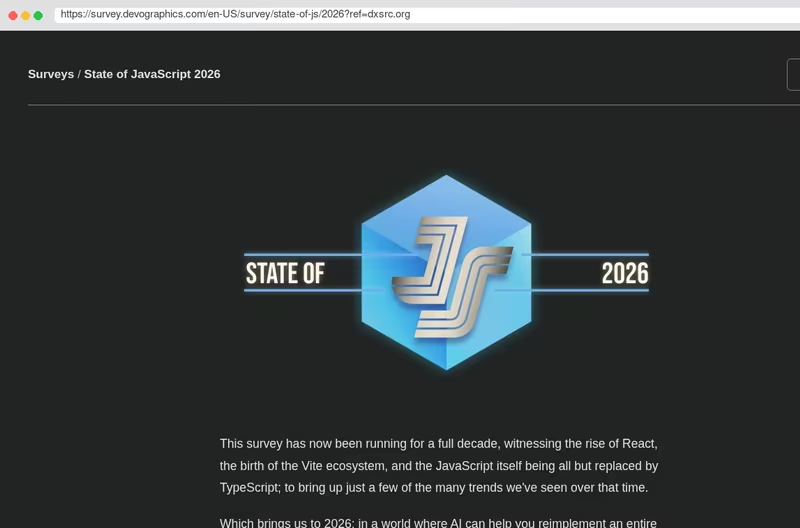
State of JavaScript 2026. @sachagreif@front-end.social and Devographics opened the survey for its tenth year, asking what role JavaScript still plays as AI agents, framework porting, and Rust rewrites reshape the ecosystem. It remains the gateway to the browser, so knowing the platform still matters. It takes about 15–20 minutes, and all questions are optional. Don’t forget to vote for your favorite resources and add anything new to your reading list. #js #survey

survey.devographics.com/en-US/…

“State of JS 2026” logo with sections AI, Resources, About You, Features, Front-end Frameworks, Build Tools, Other Tools, Meta-Frameworks, Back-end Frameworks, and Testing.

Je viens de mettre en production sur le site Autour du 1er mai les filtres post-recherche. Voir cet exemple de recherche sur le terme cooperative.

Contrairement à la possibilité déjà existante de ScrutariVerified webpage of the author (scrutari.net) de faire une recherche réduite aux résultats d’une recherche déjà existante, cette nouvelle interface travaille sur la recherche en cours uniquement du côté client et met en valeur tout le travail d’indexation des films du site Autour du 1er mai.

Keyboard shortcuts

Navigation

Home g h
Feed g f
Messages g m
Notifications g n
Your profile g p
Search /

Actions

Write a new post n
Send the post or message you are writing ⌘/Ctrl ↵
Next post in the feed j
Previous post in the feed k

General

Show this help ?
Close menus and dialogs Esc

The single-key shortcuts pause while you type, and are off on phones and tablets.