Posts by Stefan Wintermeyer · 1K posts

All Own posts Reposts Replies

Stichwort #digitaleSouveränität: Hat jemand hier praktische Erfahrungen mit einem de-googled Smartphone? Ich finde /e/OS von Murena ganz charmant, bin aber doch zu unsicher, mein Handy zu zerschießen. Ich wünsche mir die volle Funktionalität meines bisherigen Smartphones. Fragezeichen habe bei den Funktionen:

  • Apps aus dem Google App Store. Denn seien wir ehrlich: Ein paar werden fehlen
  • Funktioniert meine Postbank App noch? Ohne geht es nicht
  • Funktionieren “find my phone” und gibt es eine Fern-Löschung bei Verlust?
  • Was ist mit NFC Payment?
  • Gibt es RCS Chat?

Nach meinen Recherchen glaube ich, dass alles bis auf den letzten Punkt gehen wird. Bin aber wie gesagt nicht sicher genug, es zu riskieren.

Wer weiß es?

9
From other networks 2

2 replies

Already counted in the numbers above.

Pilze sammeln. Da musste man schon immer aufpassen. Das hat sich auch im KI-Zeitalter nicht geändert.

“Von circa 10.000 bekannten Pilzarten in Deutschland seien ungefähr 200 essbar … Eine sichere Pilzbestimmung alleine mit einer App ist nicht möglich.”

heise.de/hintergrund/…

Replying to @Gina@fosstodon.org

Berlin is such a cliché. If you really want to move to Germany, move somewhere else and not to Berlin or Munich. Of course this is Germany too but not the normal Germany.

It is as if I’d say “I want to move to the US. Should I move to New York or Texas?”

It is just a promise. But you are young. So, go to Berlin and learn from that mistake. 😉

But please do get back to me in two years and tell me if I was right or wrong. You’ll find me at vutuv.de

Berlin
Berlin
From other networks 1

1 like

@Gina@fosstodon.org liked this

Already counted in the numbers above.

Replying to @Gina@fosstodon.org

Berlin is such a cliché. If you really want to move to Germany, move somewhere else and not to Berlin or Munich. Of course this is Germany too but not the normal Germany.

It is as if I’d say “I want to move to the US. Should I move to New York or Texas?”

Are there any Australian newspapers or TV stations which posts news updates to Fediverse accounts?

From other networks 1

Reposted by Stefan Wintermeyer

Florian Lancker @Lancker metalhead.club

Meine Traumbrille. Kein Bildschirm, kein Display, kein Schnickschnack. Brauch ich eh nicht.

Nur eine Kamera, die dahin guckt, wo mein Kopf hinguckt. Und ein kleiner Lautsprecher mit Knochenschalltechnologie am Ohr.
Ich frag: „Was ist vor mir?” – „Eine Treppe, drei Stufen runter, Geländer rechts.”
„Welcher Bus kommt?” – „Linie 5.”
„Wer winkt da?” – „Deine Nachbarin.”
Sie liest mir die Speisekarte vor, warnt mich vor dem E-Roller auf dem Gehweg und sagt mir, ob das Klo für Herren ist.
Offline. Ohne Abo. Ohne dass ein Konzern mitguckt.
Und mit Hilfsmittelnummer.
Liebe Entwickler: Bitte. Ich wart hier.

RP Blind Hilfsmittel KI SmartGlasses

Replying to @wintermeyer

Logo einbinden wollte ich gerade machen. Da war schon jemand schneller. :-)

Ich glaube, das mit dem Palindrom hat dann doch nicht so einen enzyklopädischen Wert … ;-)

1

Logo einbinden wollte ich gerade machen. Da war schon jemand schneller. :-)

Krass wie schnell das teilweise geht. Danke!

From other networks 1

1 like

@Lokal_K@social.cologne liked this

Already counted in the numbers above.

Replying to @wintermeyer

Habe »Zonenkinder« auch gelesen und finde es sehr gut. Ich bin als Wessi im niedersächsischen Zonenrandgebiet aufgewachsen. DDR-Fernsehen gehörte bei uns ganz normal zu den 5 vorhandenen TV-Programmen, meine Eltern schauten Unterhaltung (»Kessel Buntes«), ich »Mach mit, mach‘s nach, mach‘s besser« und »Die Olsenbande«. 1986 habe ich zweimal eine Jugendgruppenreise in die DDR mitgemacht (nein, nicht von der DKP organisiert, sondern offiziell von der Jugendpflege unseres Landkreises). Will damit nur sagen, dass ich dadurch eine andere Sichtweise auf die DDR hatte als bei Wessis sonst verbreitet und das »Zonenkinder«-Buch deshalb für ein besseres Verständnis nur empfehlen kann.

Ebenfalls sehr empfehlenswert in dem Zusammenhang, aber deutlich sachlicher aufgesetzt, ist »Lütten Klein« von Steffen Mau. Lütten Klein ist ein Stadtteil von Rostock, in dem Mau aufwächst und Umbruch und Transformation erlebt.

1

Ich bin in Rheinland-Pfalz aufgewachsen. Wir haben Verwandtschaft auf Rügen. Gefühlt bin ich jedes Jahr einmal mit meiner Mutter dorthin gefahren. Ende 70er und 80er Jahre. Kurz vor Mauerfall zusätzlich eine Woche Klassenfahrt in die Ecke von Erfurt.

Replying to @wintermeyer

Hallo, das Logo (vorzugsweise als svg-Datei) in die Wikimedia Commons hochladen und dann in der Info-Box der Wikipedia-Seite einbinden. Kann dir bei Bedarf gerne helfen.

Beim Wikipedia-Artikel fehlt mir persönlich noch eine Beschreibung, warum die Plattform “vutuv” heißt. Wo kommt der Name her, wie ist er enstanden? Was hat er mit Business-Netzwerk zu tun? …? Hast du da was? Dann kann ich das gerne ergänzen.

Ich habe den soeben Artikel “gesichtet”.

1

Wo kommt der Name her, wie ist er enstanden?

vutuv ist ein Palindrome. Ist ein Faible von mir. Hat keine weitere Bedeutung.

Ich habe den soeben Artikel “gesichtet”.

Danke!

Kann dir bei Bedarf gerne helfen.

Darauf komme ich gerne zurück. Wie ich gerade rausgefunden habe, ist die Datei schon seit 10 Jahren auf Wikimedia Commons. Unter commons.wikimedia.org/wiki/…

Kannst Du das einbauen?

vutuv wikipedia
vutuv wikipedia
1

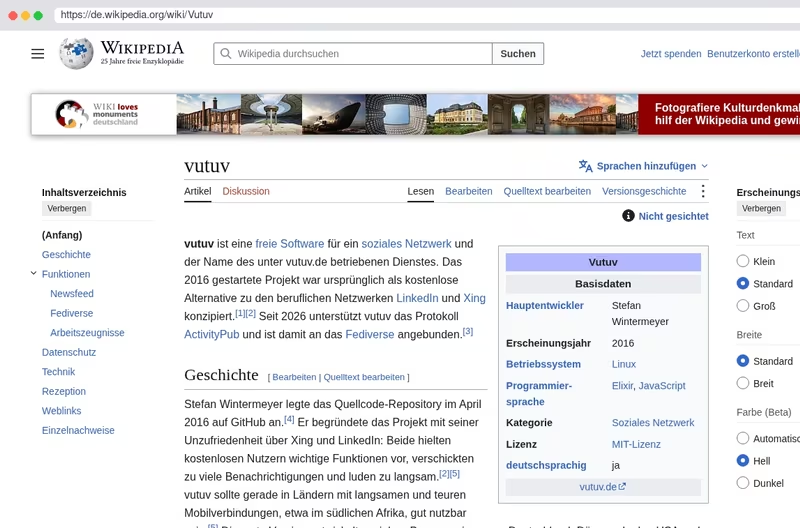
Es gibt jetzt einen Wikipedia-Eintrag zu vutuv.

de.wikipedia.org/wiki/…

PS: Weiß jemand, ob ich da ein Logo uploaden darf oder ist das nicht gerne gesehen?

vutuv wikipedia
vutuv wikipedia

Wo genau gehört das Logo hin?

1
From other networks 1

1 reply

Already counted in the numbers above.

Hallo Welt!

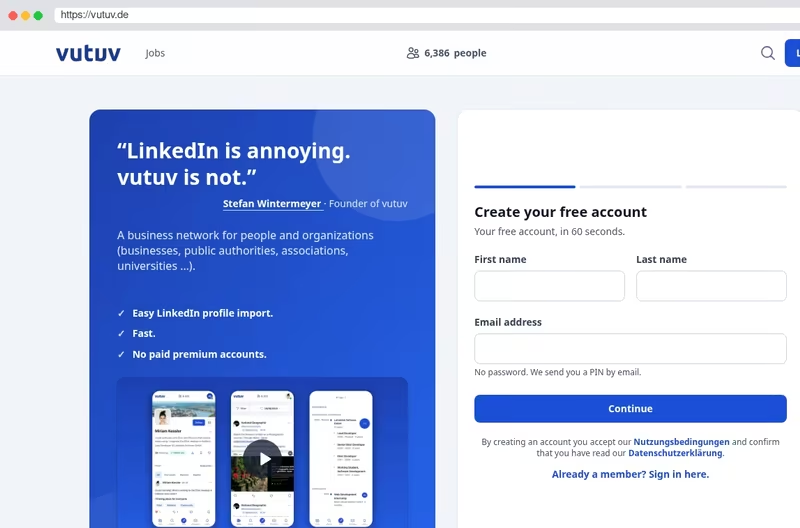
Schön hier zu sein. Ganz toll, dass es endlich jemand geschafft hat eine funktionierende, föderierte Open-Source Alternative zu den verstaubten und wenig nützlichen Plattformen an den Start zu bringen.

Ich exportiere gerade mein LinkedIn profil und werde mein Profil dann überarbeiten.

Derzeit bin ich selbstständig, stelle jedoch fest dass die Verhältnisse zu scharf für meine Gesundheit geworden sind. Also suche ich jetzt wieder in Wiesbaden und Umgebung nach Arbeit. Mit Vorliebe in basisorganisierten Betrieben oder Koops. Wer jemanden mit guter Auffassungsgabe und vielseitigem Profil sucht wird bei mir fündig. Ich kann von der Hilti über den Kabeltester bis zum Riscv bootloader so ziemlich alles bedienen und konfigurieren. Ich habe diverse eigene Apps herausgebracht und orchestriere einige Dutzend Systeme täglich. Als gelernter Kaufmann bin ich zudem gut in Buchhaltung und Sales.

Verfügbar bin ich ab sofort, pkw vorhanden.

Beste Grüße

Alex

Willkommen bei vutuv, Alex! Schön, dass du hier bist.

Replying to @WinFuture@mastodon.social

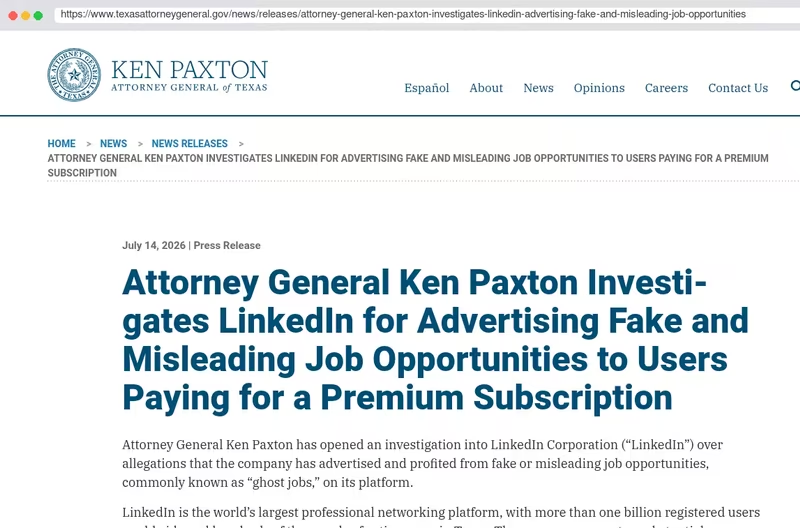
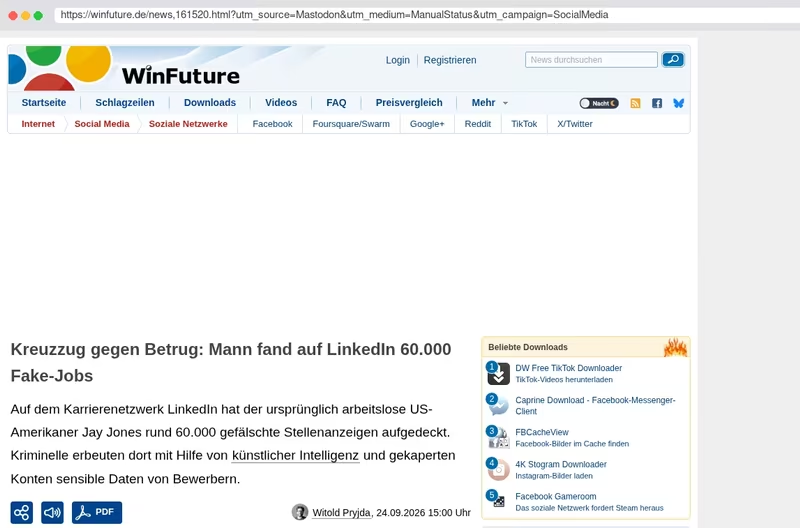
Dann muss der Nutzer aufpassen, dass er nicht gesperrt wird, weil er ein Geschäftsmodell verhindert: Der texanische Generalstaatsanwalt Ken Paxton hat am 14. Juli 2026 eine Untersuchung gegen LinkedIn eingeleitet. Hintergrund sind Vorwürfe, dass die Plattform von gefälschten oder inaktiven Stellenausschreibungen (sogenannten „Ghost Jobs“) profitiert und diese fördert.

Wichtige Details der Untersuchung

  • Die Vorwürfe: Nach Angaben der Generalstaatsanwaltschaft prüft LinkedIn den Einstellungsstatus der meisten Stellenanzeigen nicht unabhängig. Der Bundesstaat behauptet, LinkedIn verschweige, dass ein Großteil der Anzeigen inaktiv oder unbesetzt sein könnte. Dies täusche Nutzer, die für kostenpflichtige „LinkedIn Premium“-Abonnements bezahlen (die etwa 39,99 bis 69,99 US-Dollar pro Monat kosten).
  • Eingeleitete rechtliche Schritte: Die Generalstaatsanwaltschaft hat eine zivilrechtliche Ermittlungsanordnung (Civil Investigative Demand) erlassen. LinkedIn muss nun interne Mitteilungen, Daten und Dokumente bezüglich seiner Marketing-, Werbe- und Stellenverifizierungspraktiken offenlegen. Eine Klage oder formelle Anklage wegen Fehlverhaltens wurde bisher nicht eingereicht.

texasattorneygeneral.gov/news/…

From other networks 1

1 repost

@nosy@chaos.social shared this

Already counted in the numbers above.

Reposted by Stefan Wintermeyer

Wolfie Christl @wchr mastodon.social

News hat Beschäftigte von österreichischen Inlands- und Militärgeheimdiensten identifiziert, ihre Wohnhäuser, Arzt- und Friseurbesuche - auf Basis eines kommerziell erwerblichen Datensatzes aus der digitalen Werbung, der Standortdaten von 562.448 (!) Smartphones in Österreich enthält:
news.at/investigativ/…

Replying to @wintermeyer

Hallo,

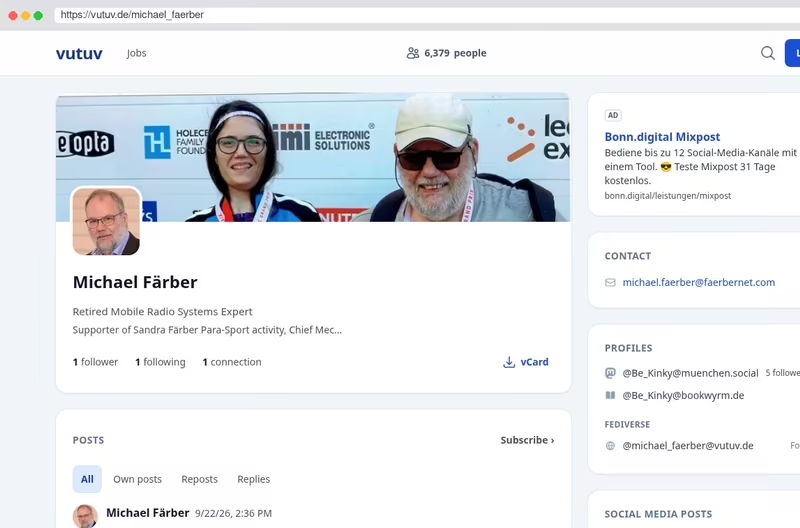
danke für den Einbau von Bookwyrm. Habe es getestet und konnte es in mein Profil, mit meiner Adresse einfügen.

Gruß Micha

1

Und ich sehe deine Buchbesprechungen auf dem vutuv.de/michael_faerber Profil.

Sehr cool! Gefällt mir. Danke für Deinen Input.

vutuv Bookwyrm
vutuv Bookwyrm

Es gibt jetzt einen Wikipedia-Eintrag zu vutuv.

de.wikipedia.org/wiki/…

PS: Weiß jemand, ob ich da ein Logo uploaden darf oder ist das nicht gerne gesehen?

wikipedia vutuv
wikipedia vutuv

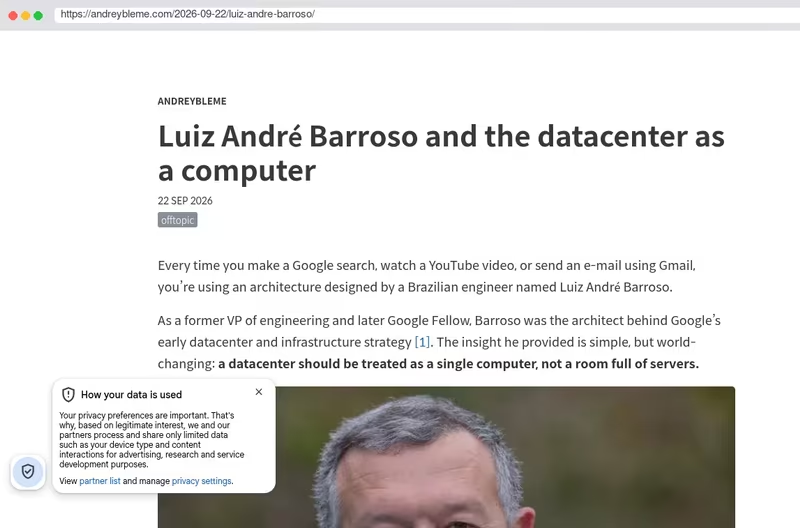
Luiz André Barroso helped redefine how computing infrastructure is built: instead of treating a datacenter as thousands of individual machines, treat the whole building as one enormous computer.

This article tells the story behind that idea, Google’s warehouse-scale computing, and how Barroso’s work on energy efficiency, hardware, software, and system design helped lay the foundations for modern cloud computing — and ultimately the massive AI datacenters they are building today.

andreybleme.com/2026-09-22/…

ComputerArchitecture cloudcomputing datacenters

Reposted by Stefan Wintermeyer

Adfichter @adfichter infosec.exchange

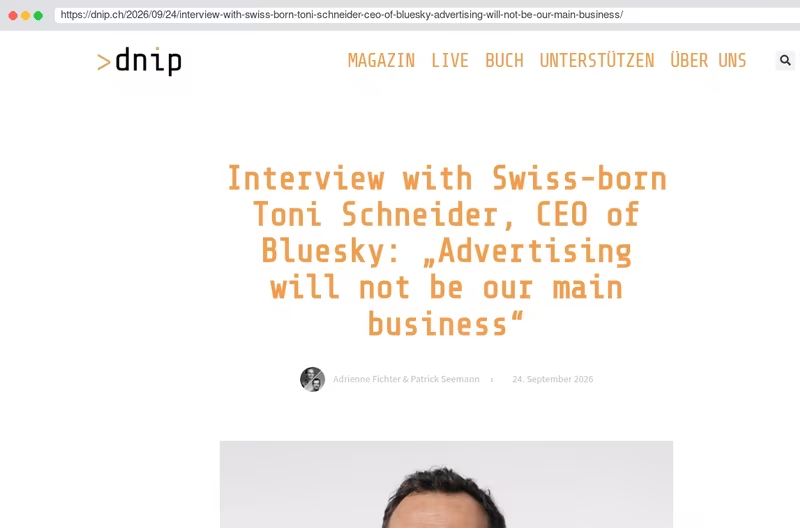
Interview with Swiss-born Toni Schneider, CEO of Bluesky: „Advertising will not be our main business“

How is Bluesky funded?

The investor money will last for a few more years. All data in ATproto is public; anyone can view it by using the open version of the Firehose and the PDS. However, we now also have a new version for companies that want to work with us – essentially the enterprise version. We’re already getting enquiries, and we’re going to monetise those. It’s a bit like Amazon’s AWS, but for the ‚Atmosphere‘ instead of the web: PDS hosting, the Firehose, and there will be more to come.

On the consumer side, meaning within the app, we are seeing commercial business models emerging in the network: people doing fundraising, selling newsletter subscriptions, or selling independent games. This is proving very successful, precisely because there is no advertising on our network. We send millions of clicks to various publishers every day – and that’s already happening organically.

That is where we want to step in and make it easier to buy and sell things on the network. It will take a while, but that is our next goal. We will take a percentage, similar to an app store model, but much less than the usual 30 per cent. And it will be an open system: not just our payment system, but several, usable not only in Bluesky but in all apps across the network. Content purchased in one app should also be usable in others. So it’s never just about one company or one app, but always about being part of the entire network.

We aren’t ruling out advertising, but we don’t want it to become our primary revenue model. It also doesn’t work well in a decentralised system; most apps don’t want ads. There are a few companies developing open social ad systems – if those work, we would give them a try, but we aren’t working on that ourselves.

What does the future look like beyond microblogging?

In the initial phase, it was about providing an alternative to Twitter and Threads, and the apps are all very similar but work together – which is good because it’s now an open system. However, we want to see many more apps emerge that aren’t just for microblogging. The next chapter of this story involves thousands of different apps and communities that all stay connected but no longer just focus on microblogging.

We are already seeing this every day: games, event apps, group apps. The latest part of the protocol is called ATProto Spaces, and it’s about private data and private communities. This is the number one request from our users and developers: not always being on a public app where everything is visible, but moving back towards private groups. That is actually the original idea of social networking, which doesn’t really exist on social media anymore.

About two weeks ago, this was released as an alpha version, and we are already seeing dozens of new apps trying it out. The Bluesky app itself will continue to grow, but we also want to bring in all the other apps that offer new forms of social networking.

What exactly does „private“ mean here – non-public or encrypted?

Non-public. You can create a Space and control access. The fundamental idea of ATproto is that user data belongs to you: there isn’t one database per app, but millions of small databases per user – the PDS, or Personal Data Server. It belongs to you, you can host it yourself, and it works with all apps.

For private data, you can create a dedicated PDS for a Space that belongs to the people who create it. Only those in the group can see the data. This could be for publishers who want to sell articles, or for a private group chat. The important thing is: everything remains user-owned. The app is just a „lens“ – as Bluesky, we don’t actually have control over the data itself.

How do you deal with different international laws?

That’s one of the reasons why it’s expensive and difficult for small companies to get into the business. We have two lawyers on the team; Meta has thousands. It’s particularly difficult with age restrictions – every country, every state has different rules that are constantly changing. On top of that, there are the various data privacy regulations, which are especially complicated in Europe, and with more AI in products, it’s going to get even more complex.

In our case, it’s different in that the app and the data aren’t in the same place. When it comes to deletion or information requests, it’s less about moderation and more about the system we have in place for it.

And requests from law enforcement agencies?

They happen all the time; it’s been that way for years, and it’s relatively stable, especially in America and Europe. We also reject a lot and have transparency reports – but because it’s been running for a while, it’s a fairly established process.

What about requests from authoritarian states – for example, data on journalists or dissidents?

We would certainly say no. We have very little data; the system is designed that way. If a PDS is hosted elsewhere, such as on Eurosky, we have zero control over the data. Direct messages are private with us, but not encrypted – not a good system for very sensitive content. If someone needs that, we say: someone else should develop it. For example, there is Germ, a system that enables encrypted direct messages on ATproto without having to reveal your phone number. Bluesky has already integrated this; you can communicate via a button directly through it.

Jay Graber said the system is „billionaire-proof“. Would you repeat that?

Yes, so far it is. If we sell Bluesky tomorrow, the rest of the system – the protocol – is independent. Realistically, other projects would have to step in to take over certain services that we provide for free today, such as the Firehose. There are already smaller projects doing that. We’ve had two major DDoS attacks in the last two months that paralysed our network for hours – other projects like Black Sky continued to run completely normally, independent of us and yet one hundred per cent interoperable. Unlike Twitter under Elon Musk, users could immediately switch to another app and carry on without anyone noticing.

Eurosky and WSocial have launched in Europe and are building on ATProto – how are you observing this?

Europe is very interesting at the moment because everyone is looking for alternatives – even more so in Europe, because America has isolated itself in recent years and European companies feel they now have to do it themselves. Data sovereignty is a major topic, especially in social media, and we are seeing extreme interest there.

We are an American company and we support other projects doing this from Europe. Eurosky was first and is doing a great job: non-profit, part of the open system. WSocial is the second; they take a more traditional approach with a private company that has raised over 20 million euros, and they bring people in more through marketing.

For us, both are very good; we support both and hope they work together – and that there will be even more, because it takes more than just two.

dnip.ch/2026/…

Reposted by Stefan Wintermeyer

Florian Lancker @Lancker metalhead.club

𝓢𝓸 𝓼𝓬𝓱𝓻𝓮𝓲𝓫𝓽 𝓶𝓪𝓷 𝓬𝓸𝓸𝓵 hier, oder?
Mein Screenreader liest das Buchstabe für Buchstabe als „mathematisches fettes Schreibschrift-S”. Ein Satz dauert eine Minute.
Dazu Emoji-Ketten 🔥🔥🔥🔥🔥, die mir jedes einzeln vorgelesen werden. Und #hashtagsallesklein, die als Buchstabensalat rauskommen.
Wenn ich’s anspreche:
„Sieht halt schöner aus.”
„Stell dich nicht so an.”

Schön für dich. Unlesbar für mich.
Schreib normal. Und Hashtags mit Großbuchstaben:

#SoGehtDas

Und nur unten nicht im Text!

Today’s Rails World 2026 talk by DHH was special. I think it just became an instant classic. youtube.com/watch?v=V9SxpJpHuus

Highlights:

  • WebApps are dead since it is so cheap, easy, and fast to build native apps with agentic coding.

  • No need for a framework like Ruby on Rails if you can achieve the same functionality with e.g. Rust on the backend while saving a lot of money by reducing the number of needed servers and having a faster application.

  • Your application needs a CLI. Because agents love command-line tools.

So the inventor of a very popular framework uses the keynote of THE main conference for that framework to tell the audience, which consists only of developers who use that framework every day, that his own company stopped using the exact framework for the next version of one of their key products. BOOM!

Ruby on Rails Ruby AgenticCoding Rust
1
From other networks 2

Replying to @wintermeyer

it is possible that you see, in the near future, more and more french speaking people on vutuv 😂

1

Keyboard shortcuts

Navigation

Home g h
Feed g f
Messages g m
Notifications g n
Your profile g p
Search /

Actions

Write a new post n
Send the post or message you are writing ⌘/Ctrl ↵
Next post in the feed j
Previous post in the feed k

General

Show this help ?
Close menus and dialogs Esc

The single-key shortcuts pause while you type, and are off on phones and tablets.